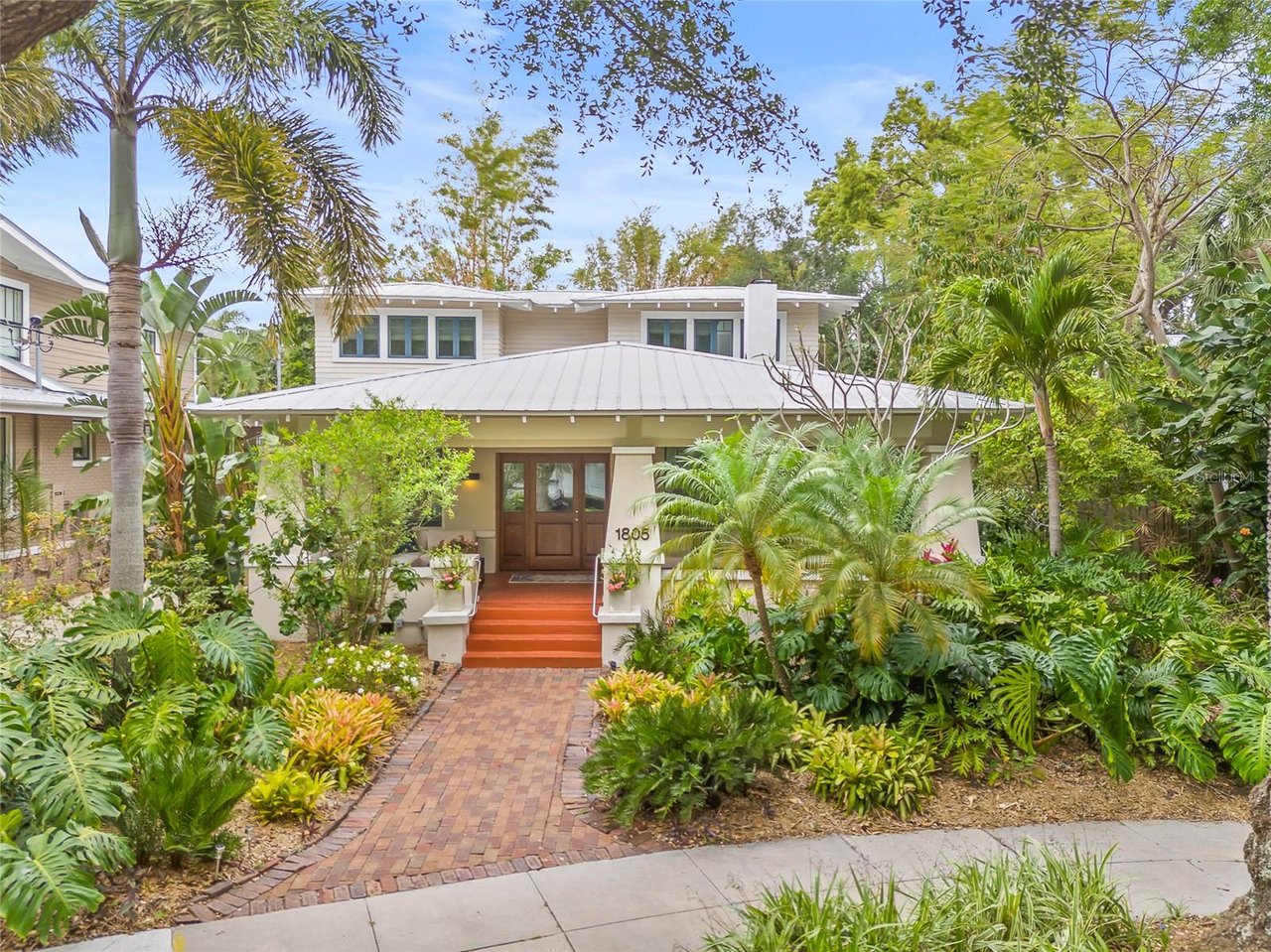
Buying a Home in Hyde Park, Tampa: A Neighborhood That Earns Its Reputation
Character Homes Mark Middleton April 17, 2026
Character Homes Mark Middleton April 17, 2026
Some neighborhoods in Tampa have a reputation built on marketing. Hyde Park has a reputation built on more than a century of actually being worth it.
This is Tampa's oldest surviving residential neighborhood — a place where the streets were laid out before most of Florida's great cities existed, where the houses have original hardwood floors and working fireplaces and front porches wide enough to mean something, and where the walk to dinner does not require a car or an explanation. It is the kind of neighborhood that people spend years working toward and then stay in for the rest of their lives. That combination of ambition and permanence tells you something important about what it is like to buy here.
If Hyde Park is on your list, this post is written specifically for you.
The story of Hyde Park begins in 1886, when a man named O.H. Platt purchased farmland on the south bank of the Hillsborough River and named his new subdivision after his hometown in Illinois. Two years later, railroad baron Henry B. Plant built the first bridge across the Hillsborough at what is now Kennedy Boulevard, connected the neighborhood to the heart of Tampa, and set off a residential boom that shaped the area's architectural character for the next five decades.
The earliest homes — built between the 1880s and the turn of the century — were Queen Anne and Colonial Revival structures that reflected the prosperity of Tampa's emerging merchant and professional class. As the twentieth century arrived and the neighborhood matured, Craftsman bungalows, Tudor Revival homes, Mediterranean Revival estates, and Prairie-influenced structures joined the street grid in what became one of the most architecturally layered residential districts in the entire state.
The Florida Land Boom of the 1920s added another layer, bringing Mediterranean-inspired construction that still anchors some of the most distinguished blocks in the neighborhood. When the Depression halted development, Hyde Park paused — and that pause preserved something important. The homes that were built here were built to last, and the hiatus meant that the neighborhood was never overwhelmed by the kind of rapid postwar construction that homogenized so many comparable historic districts elsewhere in Florida.
Today, Hyde Park sits on the National Register of Historic Places as a recognized historic district, and the Architectural Review Commission actively oversees the standards that ensure new construction and renovation work respects the character that generations of residents have preserved.
One of the things that draws buyers to Hyde Park — and sometimes surprises them when they start touring — is the sheer variety of what the neighborhood contains.
The stylistic range runs from Victorian-era wood frame homes with decorative carpentry details and wraparound porches to Craftsman bungalows with exposed rafter tails and tapered columns, from Mediterranean Revival stucco homes with red clay tile roofs to Colonial Revival structures with symmetrical facades and formal entries. In between, you find the vernacular and eclectic examples that reflect the neighborhood's unscripted development — homes that borrowed from multiple traditions and ended up as something genuinely their own.
What ties all of this together is not uniformity but continuity — the consistency of scale, the quality of the tree canopy, the rhythm of front porches set back from brick-paved streets, and the sense that each home was built by someone who cared about what they were making and where it would sit. That is not a small thing. It is precisely what makes Hyde Park resistant to the kind of commodification that has diluted character in comparable neighborhoods in other markets.
From a buyer's standpoint, the price range in Hyde Park reflects this variety. Craftsman bungalows with three to five bedrooms typically trade between roughly $1.2 million and $4.5 million depending on size, condition, and lot. Along Bayshore Boulevard, waterfront condominiums range from the mid-$400,000s for a one-bedroom unit to well above $7 million at the penthouse level in newer luxury buildings. Custom homes and fully restored historic estates on premium lots can reach significantly higher. What you pay is closely tied to what you are buying — and understanding those distinctions before you start seriously shopping is essential preparation.
No description of Hyde Park is complete without Bayshore Boulevard, and no buyer considering this neighborhood should underestimate what it means to live adjacent to it.
Bayshore runs along the eastern and southern edge of Hyde Park, tracing the shoreline of Hillsborough Bay for 4.5 miles in what is widely recognized as one of the longest continuous sidewalks in the United States. On any given morning, it is filled with runners, cyclists, dog walkers, and families pushing strollers — a genuine public space that belongs to the neighborhood in a way that few urban amenities in Florida manage to achieve.
The homes and condominiums that front Bayshore carry a premium that is not hard to understand. The combination of waterfront views, the energy of the boulevard, and the proximity to downtown Tampa creates a living experience that genuinely cannot be replicated elsewhere in the city. For buyers who are weighing Bayshore frontage specifically, the analysis involves not just price but flood zone designation, elevation, building age and reserve status for condominiums, and insurance — all of which require careful attention before any offer is made.
One of the most consistent things buyers say after living in Hyde Park for the first time is that they had underestimated how much the walkability would change their daily life.
Hyde Park Village — six walkable city blocks of open-air shopping, dining, and entertainment set among brick-paved streets and mature trees — is not a suburban lifestyle center. It is a genuine urban village that functions as the neighborhood's living room. The monthly Fresh Market brings local vendors, produce, and live music to the streets. The restaurants range from longstanding Tampa institutions to newer arrivals that have chosen Hyde Park for the same reason residents do: the quality of the setting.
South of Howard — known throughout Tampa simply as SoHo — extends the neighborhood's dining and social energy along South Howard Avenue, where locally owned restaurants and bars have created one of the most active street-level corridors in the city. Bern's Steak House, a Tampa landmark that has been operating on South Howard since 1956, anchors a stretch of the street that reflects the neighborhood's particular ability to hold onto its best institutions across generations.
For buyers who work downtown, the commute from Hyde Park is measured in minutes. For buyers with children, the school pipeline — Gorrie Elementary, Wilson Middle, and Plant High School, all among the most respected in Hillsborough County — is a significant part of the value proposition.
Hyde Park is not a forgiving market for buyers who arrive unprepared. The inventory is limited, the competition for well-positioned homes is real, and the due diligence required to evaluate a historic property correctly goes beyond what a standard purchase involves. Here is what serious buyers need to understand:
Historic district designation has real implications for renovation. If you purchase a home within the Hyde Park Historic District and intend to make exterior changes, the Architectural Review Commission has oversight authority over what is permissible. This is not a barrier — the guidelines exist to protect the character that makes the neighborhood valuable — but it is a reality that buyers need to understand before they project a renovation vision onto a property.
Older homes require a specific kind of evaluation. A Craftsman bungalow built in 1910 is a fundamentally different purchase proposition from a new construction home. The systems, the structure, the materials, and the maintenance history all require a level of scrutiny that goes beyond a standard inspection. Buyers who have worked exclusively in newer construction markets are sometimes surprised by what a thorough inspection of a century-old home reveals — and how to interpret what they find requires experience with this type of property.
The price per square foot varies dramatically within the neighborhood. Location within Hyde Park matters in ways that a simple price-per-square-foot comparison will not capture. A block's distance from Bayshore, proximity to Hyde Park Village, the specific street's character, and the condition and renovation quality of comparable homes all influence value in ways that require nuanced analysis rather than formula-based pricing.
Flood zone and insurance deserve early attention. Parts of Hyde Park have meaningful flood exposure, particularly properties closer to the bay and Hillsborough River. Understanding the flood zone designation, elevation certificate, and insurance cost of any specific property before you fall in love with it is responsible preparation — not premature caution.
Move decisively when the right home appears. Inventory in Hyde Park is consistently limited, and the buyers competing for the best homes are typically well-prepared and financially ready to act. Pre-approval, clearly defined priorities, and an agent who knows the neighborhood deeply are not optional advantages — they are the baseline for competing effectively.
There is a reason that Hyde Park has been one of Tampa's most consistently valuable residential addresses for more than a century, and it is worth understanding clearly before you commit to it.
The neighborhood's value is not driven by a single feature that could be replicated or replaced — it is driven by the combination of genuine history, irreplaceable architecture, proximity to downtown Tampa, access to Bayshore Boulevard, the quality of its schools, and the depth of its walkable commercial life. That combination is not an accident and not easily assembled elsewhere. It is the product of more than 140 years of investment, preservation, and community commitment — and it provides a floor of value that purely amenity-driven neighborhoods in newer parts of the Tampa Bay market simply cannot match.
Buyers who understand that are buying something durable. The ones who treat Hyde Park as just another South Tampa address are underestimating what they are actually purchasing.
I am Mark Middleton, Realtor and Broker Associate with Compass, leading the Middleton Tampa Bay team. Historic neighborhoods and older character homes across the greater Tampa Bay area are at the core of what I do — and Hyde Park is one of the markets I follow most closely and know most deeply.
If you are seriously considering a purchase in Hyde Park and want a frank, knowledgeable conversation about what is available, what is worth your time, and how to position yourself to buy well in this market, I would welcome the call.
727-871-SOLD middletontampabay.com Serving Hyde Park, Davis Islands, South Tampa, Dunedin, St. Petersburg & Greater Tampa Bay
Stay up to date on the latest real estate trends.
Ready to elevate your real estate experience? Partner with us for personalized service, unparalleled expertise, and a proven track record. Whether buying, selling, or seeking valuation, let's turn your property goals into reality. Contact us today for a journey beyond expectations.