The Peter O. Knight House and the Name Tampa Knows
On this page
A yellow cottage on South Hyde Park Avenue holds the story of a young Tampa household and the historical society that took care of the house after the family moved on.
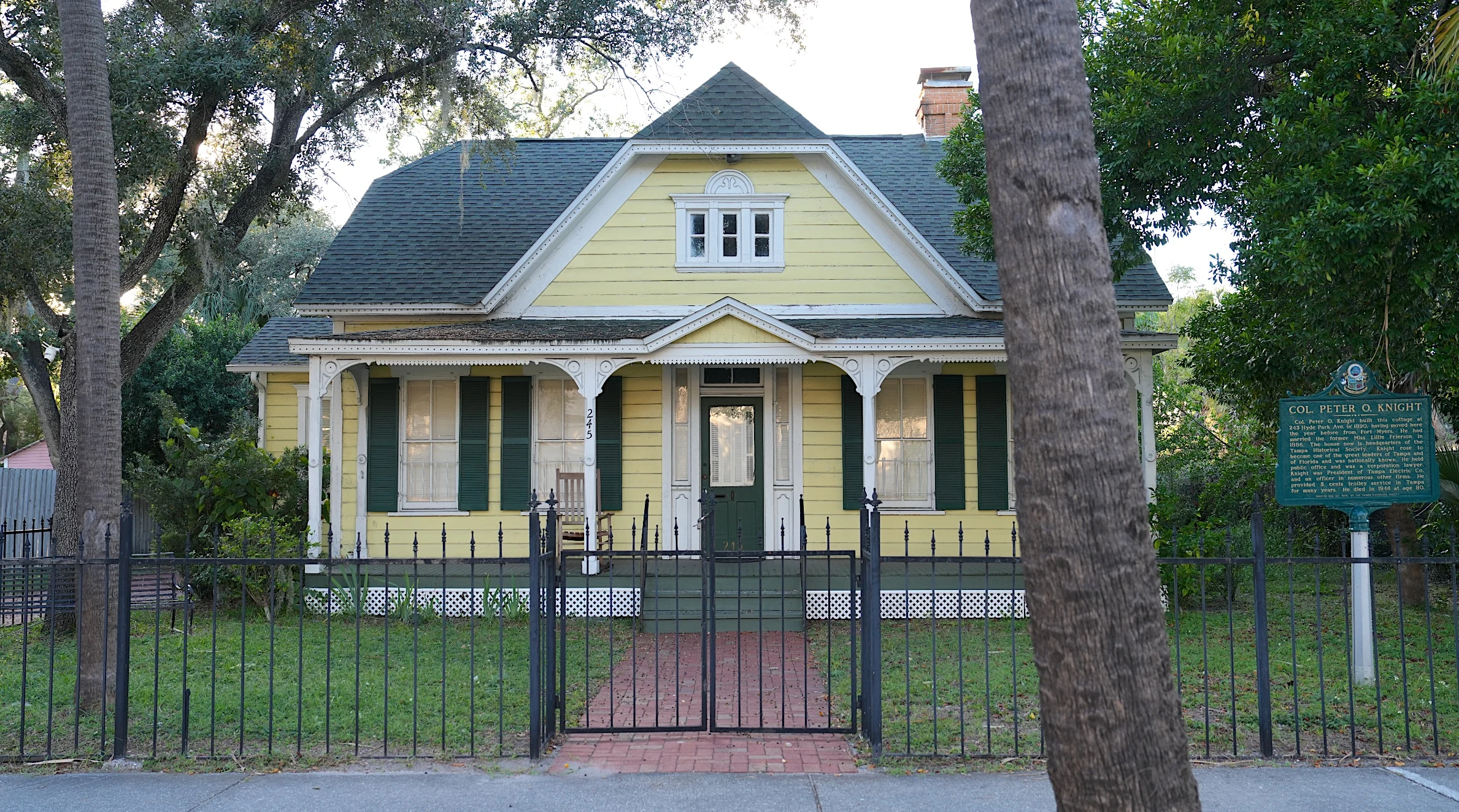
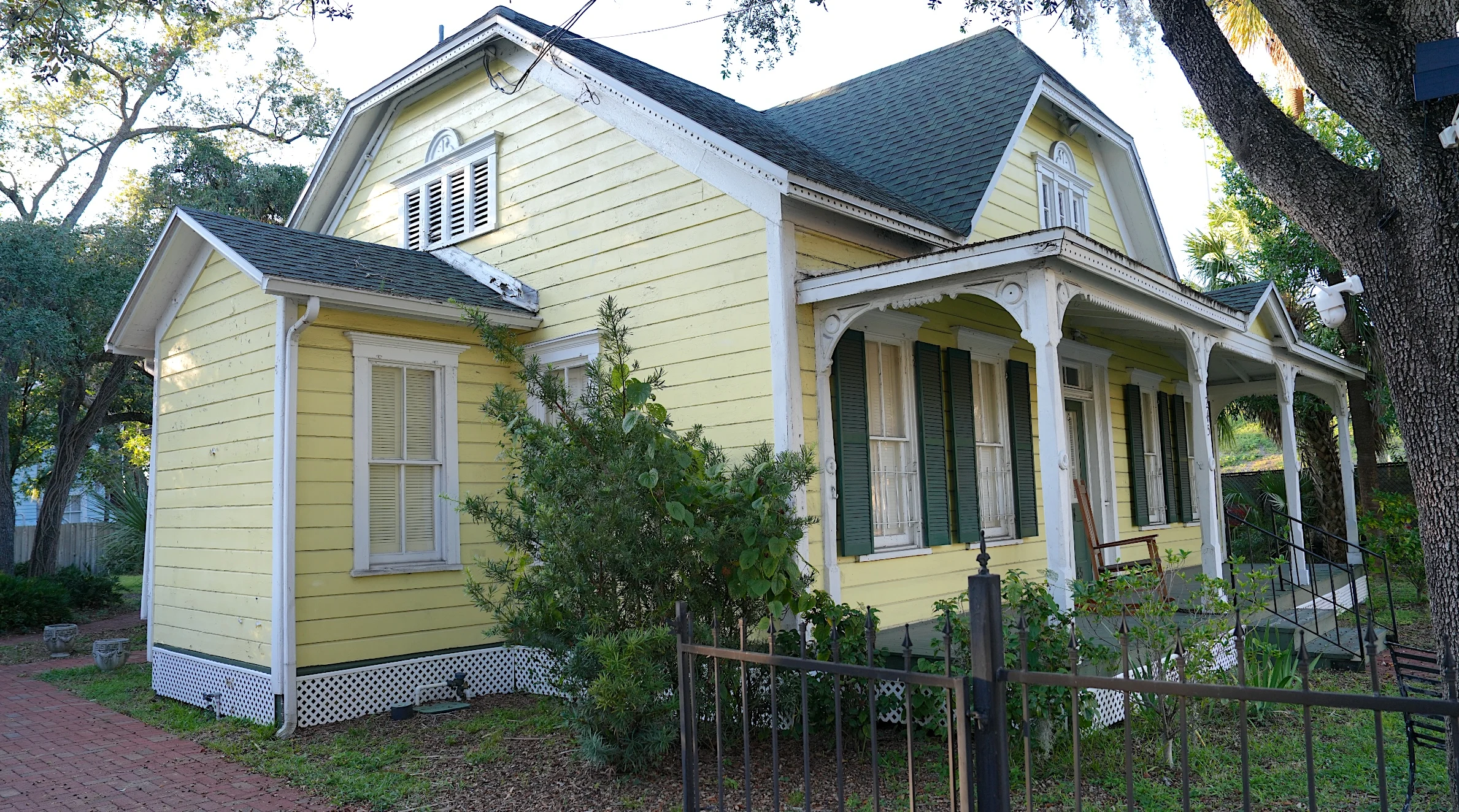
In the photograph I took from the sidewalk, a palm trunk cuts across the right side of the Peter O. Knight House. An iron fence runs along the foreground, and a brick walk leads from the gate to the front steps. I could have framed the tree out, but I like what it does for the picture. You see the cottage much as you would if you came upon it on foot, one part at a time. First there’s the yellow siding, then the white porch posts, and finally the small gable over the steps. The house is close enough to study without setting foot inside the gate.
I’ve lived in Tampa Bay since 1984, and for years the name Peter O. Knight brought Davis Islands to mind. It’s the name on Peter O. Knight Airport. There’s another way into the story at 245 South Hyde Park Avenue, where Peter and Lillie Knight made their first Tampa home. The distance between an airport and a front porch makes this an interesting stop in the series. You can start with a building small enough to take in from the sidewalk and end up reading about banking, electric power, and the people who kept records of a growing city.
The Knights’ first Tampa home
The City of Tampa’s landmark inventory dates the cottage to about 1889. The National Register nomination for Hyde Park puts it at about 1890. Both dates place it among the neighborhood’s surviving houses from before the turn of the twentieth century. The city’s historic designations book identifies it as the early home of Peter O. Knight and his wife, Lillie. The AIA Tampa Bay architecture tour describes it as a honeymoon cottage and says a larger family home later went up two blocks to the south.
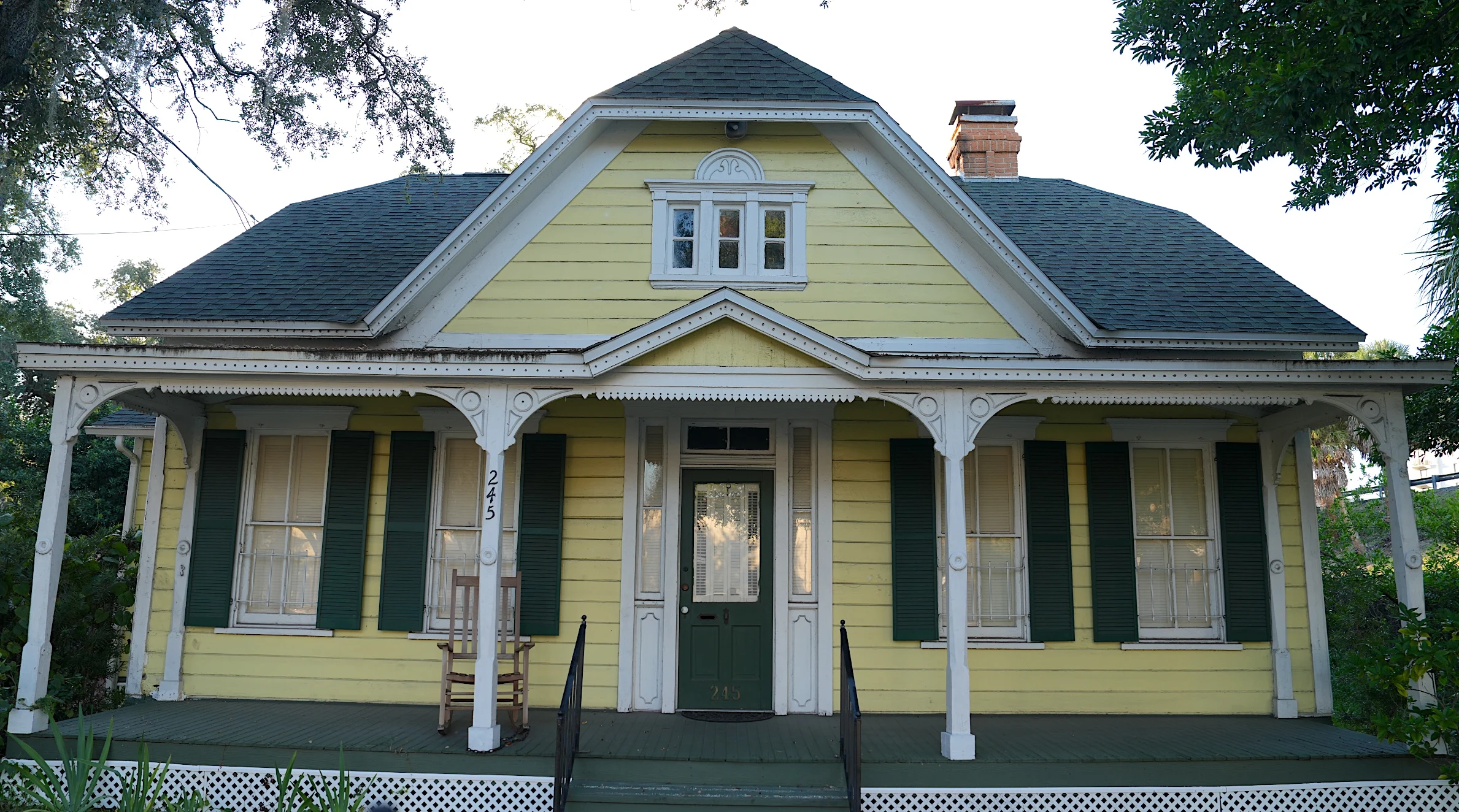
I spent more time looking at the porch than at the marker. From straight in front, the porch posts stretch across most of the house. The steps and the little gable give the entrance a clear place within that long line. Look up another level and there’s a group of three narrow windows in the larger gable. It takes a minute for all those pieces to register, especially with shade across the front. In the photograph from the side, the projecting rooms change the outline again. The whole house seems a little different every time you move.
The name on the marker and the airport
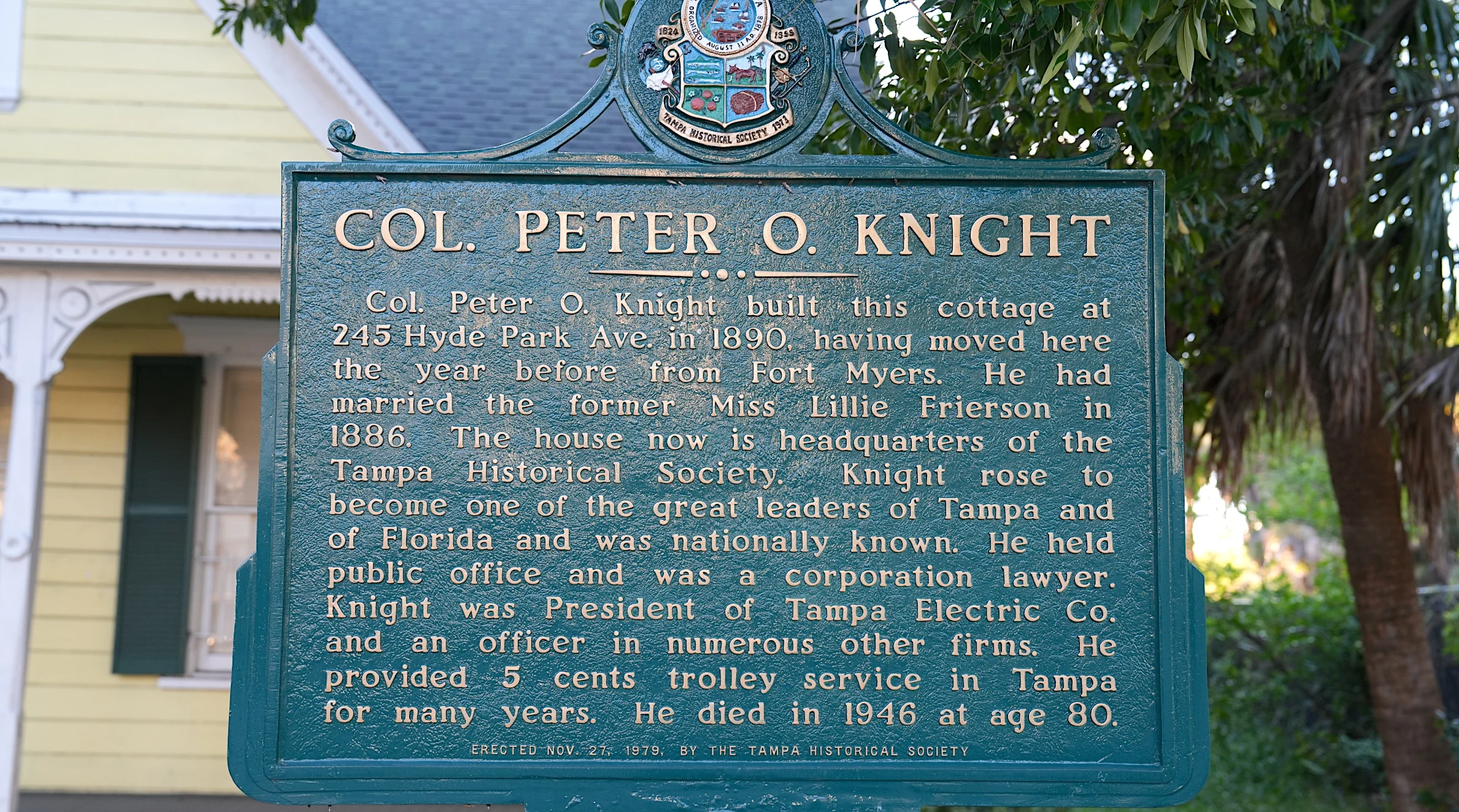
The district nomination lists Knight as a lawyer and state attorney and credits him as one of the founders of both Exchange National Bank and Tampa Electric Company. Those two names tell you something about the range of his work and the place Tampa was becoming. The city’s history of the Tampa City Council also describes his role in establishing the municipal airport on Davis Islands. Those are big civic and business stories to trace back to the small house where a couple started their life in Tampa.
It’s a connection I’ve enjoyed making throughout this series. At the Cuesta-Hixon House, a familiar name from the Riverwalk led back to a Tampa pharmacist who became mayor. The Leiman House led to the business of making cigar boxes. Here, the airport name leads back to a porch in Hyde Park. Each place gives the name a setting and a scale I can make sense of, especially when I have the time to walk past with a camera.
When the cottage became a place for Tampa history
The Tampa Historical Society acquired the house in 1977. In August 1978 the society held a ceremony to mark the conversion of the cottage into its headquarters. The account reprinted in the society’s Sunland Tribune calls it a groundbreaking, although there was no ground to break. The building was already there. What changed was the work going on inside it. The society planned space for offices, meetings, and its research collection, as well as a recreation of a Victorian parlor.
That detail about the parlor stayed with me. The society needed places to work and keep material, and it also wanted a room that would help people picture domestic life in the city. There’s a difference between reading that a family lived at an address and having a sense of what the rooms might have felt like. Preserving the cottage made room for both kinds of history. It also left a building you can still recognize from the street in the photograph that accompanies the older district records.
What I’d look for on South Hyde Park Avenue
If you pass the cottage, pause where you can see the whole front and then walk a little farther along the public sidewalk. From the straight-on view I noticed the paired shutters and the steady line of porch posts. From an angle I could see where the rooms step out and where the roofs meet. The changes are small, and they’re part of why I prefer taking more than one photograph of a house. The straight view tells me how the front is put together. The side view tells me how much I missed from the first spot.
By the time I’d finished photographing the house, the picture I wanted to keep near the top of the story was the one that showed some of the yard along with the porch. The marker can tell you what Peter Knight did. I wanted the photographs to show where the Knights lived and what remains of the place a century later. That’s the part of this work I keep coming back to. There are names we know because we’ve heard them all our lives, and sometimes the best way to learn something new about them is to find the address and take a walk. You can find my local real estate work at Middleton Tampa Bay. I share more of my Tampa Bay photography at MarkAMiddleton.com.