An Evening in Historic Old Northeast: A Neoclassical Revival Reveals Itself
Old Northeast Mark Middleton April 19, 2026
Old Northeast Mark Middleton April 19, 2026
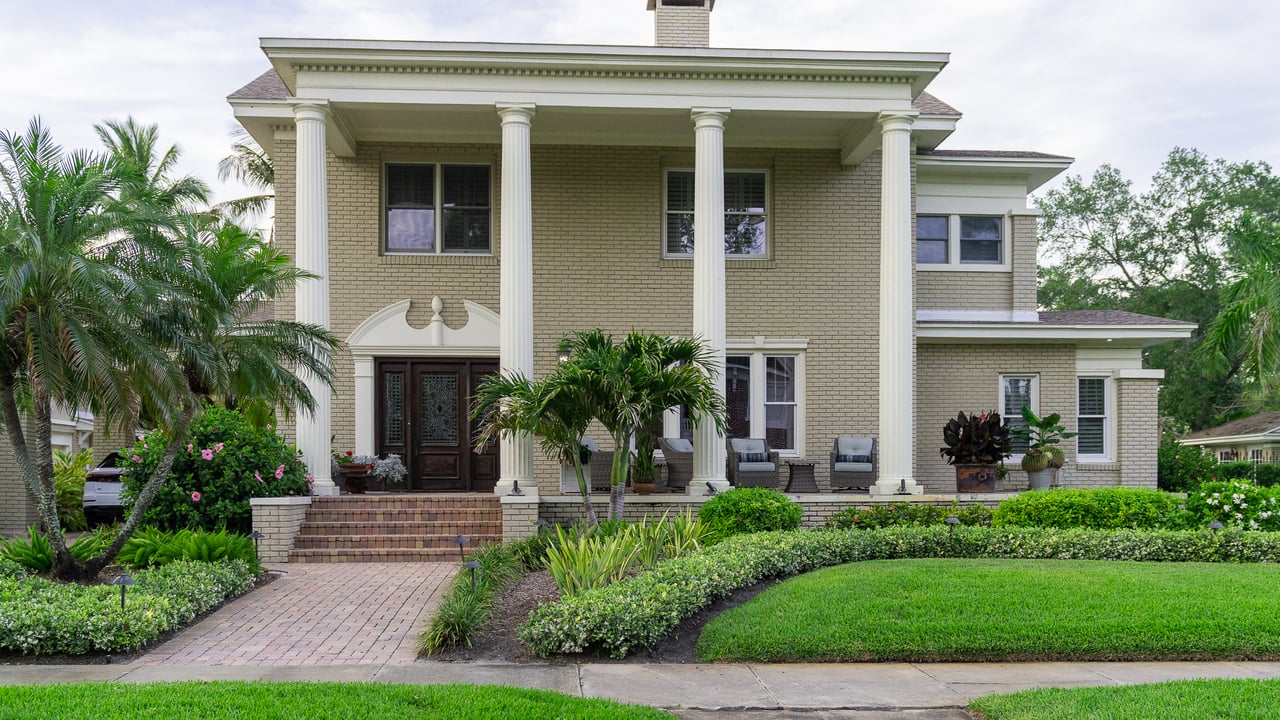
I was walking Historic Old Northeast last night, a block inland from Vinoy Park, camera in hand, when this home stopped me.
The light was doing what Florida light does at the end of an overcast day — soft, even, revealing everything without flattening it. The facade sat back from the sidewalk in that confident, unrushed way that early-20th-century homes tend to have. Four fluted columns ran the full two stories from the brick porch floor to the classical entablature above. A low-pitched hip roof capped the composition. A leaded glass door caught what was left of the evening behind an arched pediment. Pink hibiscus and carefully pruned palms softened the foundation without competing with the architecture.
I stood there for a few minutes before I took the photograph. Some homes you walk past. Some homes you stop for. This was the second kind.
I don't know this home's full history yet — I'll dig into the records at some point — but the architecture speaks clearly enough on its own. What I was looking at is a Neoclassical Revival house, almost certainly built between roughly 1905 and 1920, and it represents one of the most quietly significant architectural traditions in Historic Old Northeast.
If Craftsman bungalows and Mediterranean Revival estates are Tampa Bay's most common and most photographed historic styles, Neoclassical Revival is the more restrained and more formal cousin — a style that draws directly from ancient Greek and Roman temple architecture, filtered through the American Colonial period and then revived in the early 20th century as a conscious architectural statement.
The defining features are all present in this home. Full-height colossal columns — the columns that run two stories rather than one — are the single clearest identifier of the style. These columns typically feature classical capitals (Tuscan or Doric in this case, with their simpler, more restrained profiles) rather than the more ornate Ionic or Corinthian. The columns support a classical entablature, often including a dentil molding course along the cornice — the small, tooth-like rectangular blocks just beneath the roofline that appear in this home's composition.
The symmetry is another tell. Neoclassical Revival homes organize themselves rigorously around a central axis, with paired windows flanking the centered entry on both floors. The architectural intent is formal, civic, almost ceremonial. These were homes built to project stability, permanence, and cultural seriousness — qualities that appealed to the business leaders, professionals, and early St. Petersburg residents who wanted to signal that this fast-growing Florida city was serious, substantial, and here to stay.
The brick exterior, light in color and laid in common bond, was itself a status material in early-20th-century Florida. Most middle-class construction of the era was wood frame. Brick signaled resources, intent, and confidence in the structure's longevity.
The leaded or stained glass entry door, visible through the arched pediment above the front steps, is almost certainly original or period-appropriate — these decorative glass patterns were commissioned specifically for the home by its original builder, and their survival in restored condition is both rare and genuinely valuable.
Historic Old Northeast is one of the most architecturally coherent historic neighborhoods in Florida, and homes like this one are why.
The neighborhood was developed primarily between 1911 and the 1930s, which means it captures the full sweep of early-20th-century American residential architecture. Craftsman bungalows, Mediterranean Revival estates, Colonial Revival homes, Prairie-influenced designs, American Foursquares, and Neoclassical Revival homes all coexist on the same grid of brick-paved streets. The neighborhood is listed on the National Register of Historic Places, and its defining physical features — brick streets, hexagonal sidewalks, granite curbstones, and the signature gateway markers — have been preserved with remarkable discipline over more than a century.
What makes the neighborhood genuinely distinctive, though, isn't any single architectural style. It's the fact that these homes have been maintained, restored, and passed down through generations of owners who understood what they had. Walk any block between the downtown waterfront and Coffee Pot Bayou and you'll see original windows, original front porches, original decorative details that owners in other markets routinely replace and regret. The stewardship tradition is real, and the neighborhood rewards it.
For buyers, this matters practically. Homes in Historic Old Northeast with intact original features consistently command premiums over comparable properties elsewhere in St. Petersburg, and the spread has widened rather than narrowed as design-conscious buyers have increasingly targeted the neighborhood specifically. A home like the one in this photograph — a Neoclassical Revival with preserved architectural integrity, mature landscaping, and Vinoy Park a block away — represents the kind of inventory that doesn't transact often and doesn't stay on the market long when it does.
Location within Historic Old Northeast matters more than many buyers initially understand. The neighborhood is large enough that different blocks deliver meaningfully different experiences.
The western edge of Old Northeast, closer to 4th Street and the established retail corridor, offers walkability to everyday services — grocery, pharmacy, restaurants, coffee. The eastern edge, along Beach Drive NE and the streets running down to the waterfront, offers proximity to Vinoy Park, the St. Pete Pier, downtown, and the full cultural density of central St. Petersburg. Coffee Pot Bayou marks the neighborhood's northern boundary and delivers some of the most distinctive waterfront character in the city.
One block from Vinoy Park — which is where this particular home sits — puts you in a genuinely privileged position. You have direct access to one of Florida's most beautifully maintained waterfront parks, with its signature palms, its broad lawn, and its long views toward Tampa Bay. You're minutes from Beach Drive's restaurants, minutes from the Vinoy Resort itself, and walking distance to the St. Pete Pier. At the same time, you're insulated from the direct activity of the waterfront by a block of residential streetscape. It's the quietly best of both — immediate access without direct exposure.
Beach Drive NE, North Shore Drive NE, and the cross streets leading to the park all contain some of Old Northeast's most significant homes. The Neoclassical Revival in this photograph is one of them.
I don't know yet who built this home, who has lived in it over the past century, or the specific architect (if there was one) behind the design. These are the kinds of details I'll dig into as I have time — St. Petersburg's local history resources, city building records, neighborhood association archives, and the informal knowledge of long-tenured Old Northeast residents can usually surface substantial information about specific homes of this quality.
I'll likely update this post, or write a follow-up, once I've done that research. For now, the photograph and the architecture speak for themselves — and what they say about the neighborhood matters whether or not we have the specific names attached.
Historic Old Northeast isn't a neighborhood that reveals itself in a drive-through. You have to walk it, ideally slowly, ideally at the end of the day when the light softens and the architecture settles into what it actually is. The Neoclassical Revivals, the Craftsman bungalows with their deep front porches, the Mediterranean estates with their tile roofs, the Colonial Revivals with their symmetrical facades — they reward attention. They reward curiosity. They reward the kind of slow looking that most Florida neighborhoods have been built specifically to discourage.
For buyers considering Old Northeast, this matters. The homes you'll love here are not the ones you'll find by filtering MLS results by bedroom count and square footage. They're the ones you'll find by walking the streets, looking at the details, understanding what you're actually seeing, and working with representation that genuinely knows the neighborhood at the block level.
And for owners already here — for the stewards who maintain these homes across decades, who preserve the original windows and the original porches and the original character that make the neighborhood what it is — the work you do matters more than you probably realize. Old Northeast is what Old Northeast is because of your care. The next generation of owners who eventually take your place will inherit something worth inheriting because of you.
Whether you're considering buying a historic home in Old Northeast, preparing to sell one, or simply curious about the neighborhood's architectural heritage, I'd be glad to have the conversation. Every home in this neighborhood has its own story, and the right representation understands both the story and what it's worth.
Call 727-871-SOLD (727-871-7653) or reach out through the Contact page to start the conversation.
Stay up to date on the latest real estate trends.
Ready to elevate your real estate experience? Partner with us for personalized service, unparalleled expertise, and a proven track record. Whether buying, selling, or seeking valuation, let's turn your property goals into reality. Contact us today for a journey beyond expectations.