William Fletcher Belcher: The Early Pinellas County Developer Who Built History
Pinellas County Mark Middleton April 20, 2026
Pinellas County Mark Middleton April 20, 2026
In my recent post on the 1908 Gingerbread House at 136 4th Avenue North in Safety Harbor, I mentioned the home's builder — William Fletcher Belcher — almost in passing. But the more time I spend researching the early historic homes of Pinellas County, the more I've come to appreciate that the builders of these properties deserve attention of their own. A home like the 1908 Gingerbread House doesn't exist without the person who designed and built it. And the person who designed and built it often has a story that illuminates the entire era.
William Fletcher Belcher is one of those figures. Known today primarily through historical markers, a handful of surviving buildings, and the institutional memory of Pinellas County preservationists, Belcher was one of the formative builders and civic leaders of the region during the decades when Pinellas County was transforming from scattered springs resorts and agricultural communities into the densely-built coastal region we know today. He built homes. He developed property. He held elected office. And the work he left behind still stands in several Pinellas County communities more than a century later.
What follows is what I've been able to piece together about Belcher's life, his work, and his lasting influence on Pinellas County — as well as what I'm continuing to research. This post will be updated as new information emerges.
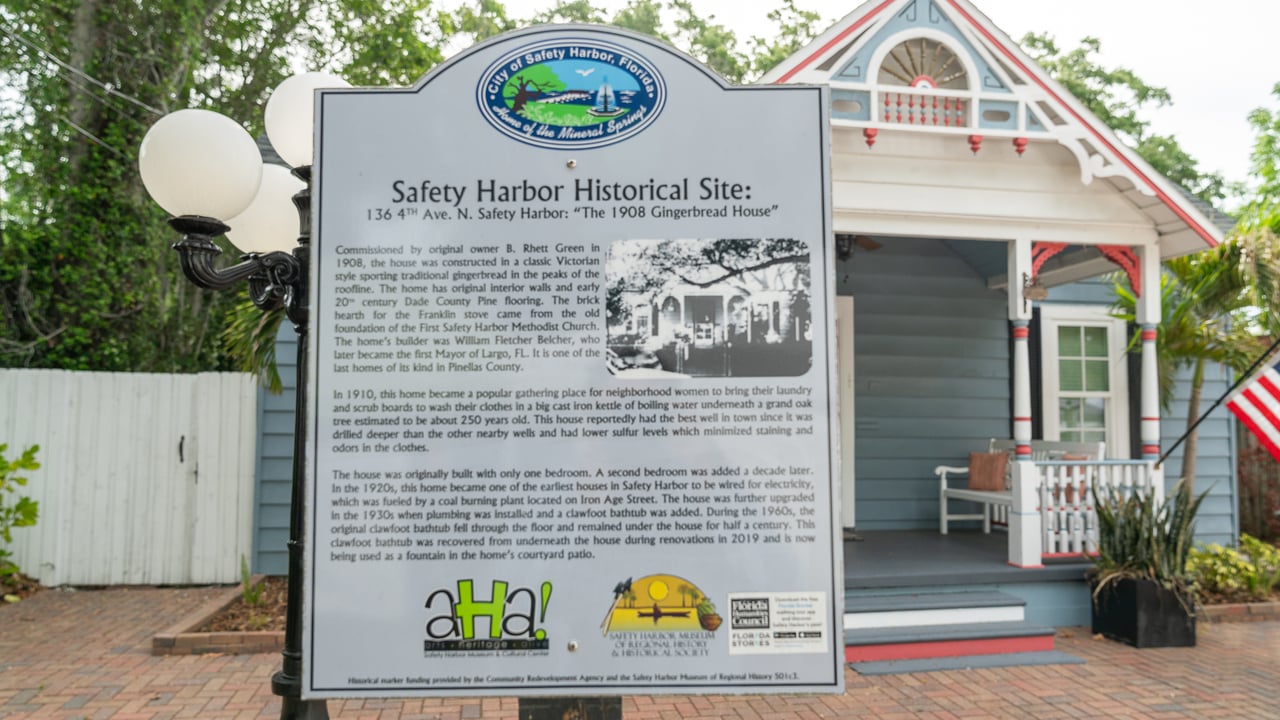
William Fletcher Belcher lived and worked during the foundational era of Pinellas County development, roughly spanning the late 19th century through the early 20th century. The historical marker at 136 4th Avenue North in Safety Harbor — installed by the City of Safety Harbor in partnership with the Safety Harbor Museum of Regional History and the aHa! Arts Heritage Alive organization — identifies Belcher clearly: he was "a major early Pinellas County developer" and "the first mayor of Largo, Florida."
These two facts alone place Belcher in a specific and significant historical category. The early developers of Pinellas County — the men who platted neighborhoods, financed construction, built the first homes and commercial buildings, and established the physical framework within which later generations would build — were the people who literally shaped the ground we walk on today. The fact that Belcher also held the first mayoral office of Largo adds a civic and political dimension that few builder-developers of the era achieved.
Pinellas County itself was not formally established until 1912, when it separated from Hillsborough County. Before that separation, the region west of Tampa Bay was a sparsely populated peninsula of small fishing villages, mineral spring resorts, citrus groves, and early agricultural settlements. Largo had been incorporated as a town in 1905, making it one of the earliest incorporated municipalities in what would become Pinellas County. Belcher's role as Largo's first mayor places him at the very origin of organized municipal government in this part of Florida.
The most documented of Belcher's surviving works is the 1908 Gingerbread House at 136 4th Avenue North in Safety Harbor. The Safety Harbor historical marker identifies Belcher as the home's builder, commissioned by B. Rhett Green and his wife Josie. The home stands today as one of the last intact Victorian Gingerbread homes in Pinellas County, with original Dade County Pine flooring, original interior walls, and decorative architectural character that has been preserved through more than a century of ownership.
What the 1908 Gingerbread House tells us about Belcher as a builder is significant. The home is not crude or hastily built — it's a piece of work that reflects real craftsmanship, attention to architectural detail, and the use of premium materials. Dade County Pine, the old-growth southern pine that gives the home its original flooring, was prized material even in its own era. The decorative gingerbread trim, steep gables, and ornamental detailing all reflect the late-Victorian and Folk Victorian traditions that were fashionable during the home's construction period. This is the work of a builder who cared about what he was building, not a developer throwing up the cheapest possible structures to meet market demand.
The home was commissioned by B. Rhett Green — another early Safety Harbor resident whose specific story is itself worth further research. The fact that a client of Green's means and social position chose Belcher as his builder suggests that Belcher had established a reputation for quality work by 1908. Builders of substandard craftsmanship do not generally receive commissions from prominent residents of a town's foundational era.
For the full documented story of the 1908 Gingerbread House — including its 1910 role as the community washing gathering place, its 1920s electrification, the 1930s clawfoot tub that fell through the floor and was rediscovered during 2019 renovations, and the home's modern transformation into a landmark mixed-use property — see my dedicated post on the 1908 Gingerbread House.
William Fletcher Belcher's service as the first mayor of Largo places him at the founding of municipal government in one of Pinellas County's most significant communities. Largo was incorporated in 1905, and Belcher's role as its first mayor means he presided over the establishment of the town's earliest civic institutions — likely including initial municipal services, early governance structures, and the framework within which the town would grow over the following decades.
Largo sits roughly in the geographic center of Pinellas County, and its early development was tied to agriculture (particularly citrus), its location along the rail corridor that ran north-south through the county, and its emerging role as a regional commercial center. For a man of Belcher's generation — simultaneously a working builder, a property developer, and the town's first elected mayor — the work would have been comprehensive. He was quite literally building Largo in two senses at once: the physical buildings that constituted the town, and the civic framework within which the town would function.
Largo today retains significant historic architectural character in portions of its downtown core and in older residential areas, though much of the town's historic fabric has been lost to mid-century and later development. Identifying specific Belcher-built properties in Largo is part of the ongoing research that a post like this one is designed to support. If any readers have specific knowledge of Belcher-built homes or commercial buildings in Largo, that information would be genuinely valuable to add to this record.
Beyond the documented 1908 Gingerbread House and his role as first mayor of Largo, William Fletcher Belcher's broader development work across Pinellas County deserves more systematic documentation than currently exists online.
Early Pinellas County developers typically operated across multiple communities during their careers. A builder based in Largo or Safety Harbor in the early 20th century would likely have worked not only in those immediate communities but also in Clearwater, Dunedin, Tarpon Springs, Oldsmar, Seminole, and the various smaller communities that dotted the peninsula. The construction work of this era — homes, commercial buildings, civic structures — was often carried out by relatively small numbers of active builders who moved between communities as opportunities arose.
The Belcher name itself appears in several Pinellas County contexts that may or may not all connect to William Fletcher Belcher specifically. Belcher Road, a major north-south thoroughfare running through central Pinellas County, likely commemorates the family name. The Belcher family appears in early Pinellas County history in roles beyond William Fletcher's specific work — family members in farming, business, and civic life throughout the region's foundational decades.
Tracing Belcher's specific projects requires research in several kinds of sources: county building permit records where they survive from this era (many early records are incomplete or lost), deed records tracing property transactions that may reveal builder involvement, historical society archives in Largo, Safety Harbor, Clearwater, and Dunedin, the Pinellas County Historical Museum in Heritage Village (which maintains archives specific to early county development), and the institutional memory of preservationists and historians who have studied specific communities in depth.
The specific question of which homes William Fletcher Belcher built matters for several reasons beyond pure historical interest.
For current owners of potential Belcher-built homes, attribution to a specific early Pinellas County builder represents a genuine piece of provenance that can meaningfully affect both appreciation of the home and eventual resale value. A home confidently identified as "built by William Fletcher Belcher, first mayor of Largo" carries documented historical weight that most early-20th-century homes cannot claim.
For buyers of Pinellas County historic homes, understanding which homes came from identified early builders helps distinguish between generic early-20th-century inventory and specifically documented historic properties. In a market increasingly sophisticated about architectural provenance, this distinction matters.
For the broader preservation community across Pinellas County, documenting the work of specific early builders strengthens the case for historic district designation, preservation tax credits, and ongoing protection of foundational-era homes. The more specific the historical record, the more defensible the preservation argument.
For the communities themselves — Safety Harbor, Largo, and wherever else Belcher worked — maintaining clear records of who actually built the foundational homes is part of civic memory. Communities that lose track of their earliest builders lose part of their own origin story.
I'll be honest about the current state of public information on William Fletcher Belcher. Beyond the documented facts from the Safety Harbor historical marker — that he built 136 4th Avenue North in 1908 and served as first mayor of Largo — comprehensive online records on his broader work are thin. Specific other homes he built, the range of dates of his active building career, his family background, his education or training as a builder, his business relationships, and the specific circumstances that led to his mayoral service — all of these deserve further research and documentation.
My ongoing research directions include:
This post will be updated as that research yields additional documented information. If any readers have specific knowledge of Belcher-built homes, Belcher family history, or primary-source materials that would help extend this record, I'd genuinely welcome that information.
Historic homes don't build themselves. Every surviving early-20th-century home in Tampa Bay reflects the work of specific builders, specific craftsmen, specific developers, and specific civic leaders whose decisions shaped what the region became. Most of these people are forgotten today. Their homes remain; their names do not.
William Fletcher Belcher is one of the exceptions — a builder whose name is preserved in at least one municipally-installed historical marker, whose civic service is part of Largo's founding record, and whose work has survived in at least one documented landmark home. Preserving and extending the record of his work is part of preserving the record of how Pinellas County actually came into being.
For anyone who loves historic homes, who lives in them, who buys and sells them, or who simply finds meaning in the physical continuity between past and present — the stories of builders like Belcher matter. They're part of the reason the homes they built continue to feel like genuine places rather than generic constructions. The craftsmanship, the material quality, the civic intent embedded in homes of this era — these are not accidents. They reflect the specific people who made specific choices to build something that would last.
If you own a home in Pinellas County that you believe may have been built by William Fletcher Belcher, or if you have family records, historical documents, photographs, or local knowledge about his work, I'd genuinely welcome the opportunity to expand this record. Contributions will be credited in future updates to this post.
Whether you own a historic home with documented provenance, a historic home whose builder and history remain unclear, or you're considering a purchase where architectural documentation is part of your evaluation — I'd be glad to discuss. Specialized historic home representation includes the research, documentation, and storytelling that transforms a historic property from a generic old home into a specifically valuable heritage asset.
Call 727-871-SOLD (727-871-7653) or reach out through the Contact page to start the conversation.
Stay up to date on the latest real estate trends.
Ready to elevate your real estate experience? Partner with us for personalized service, unparalleled expertise, and a proven track record. Whether buying, selling, or seeking valuation, let's turn your property goals into reality. Contact us today for a journey beyond expectations.