Walking Spring Bayou: An Evening in Tarpon Springs' Historic Heart
Character Homes Mark Middleton April 21, 2026
Character Homes Mark Middleton April 21, 2026
I was in Tarpon Springs yesterday afternoon, walking South Spring Boulevard with my camera, letting the light do what it does when it softens over water.
Spring Bayou on a late afternoon is one of those places that doesn't quite feel like Florida. The bayou itself curves in from the Anclote River estuary system, sheltered and quiet, the water glassy in still moments. Craig Park runs along the east side of the street. Oaks arch over the sidewalks. And the homes — the homes are what stop you. Three-story Queen Anne Victorians with curved porches and decorative millwork. Frame Vernacular cottages from the 1880s. Mediterranean Revival estates from the 1920s. Colonial Revival homes from the early 20th century. All lined up along a single street of fewer than a dozen blocks, each one a piece of how Pinellas County came to be.
I've walked this boulevard dozens of times over the years. I walk it whenever I can, honestly, because in my work specializing in historic Tampa Bay homes, there are not many streets in this region where so much architectural heritage sits in such concentration. Spring Bayou is one of them. And I think most of the people who drive through Tarpon Springs to get to the Sponge Docks have no idea what they're passing through on the way.
A bit of context worth knowing, because it changes how you see these homes.
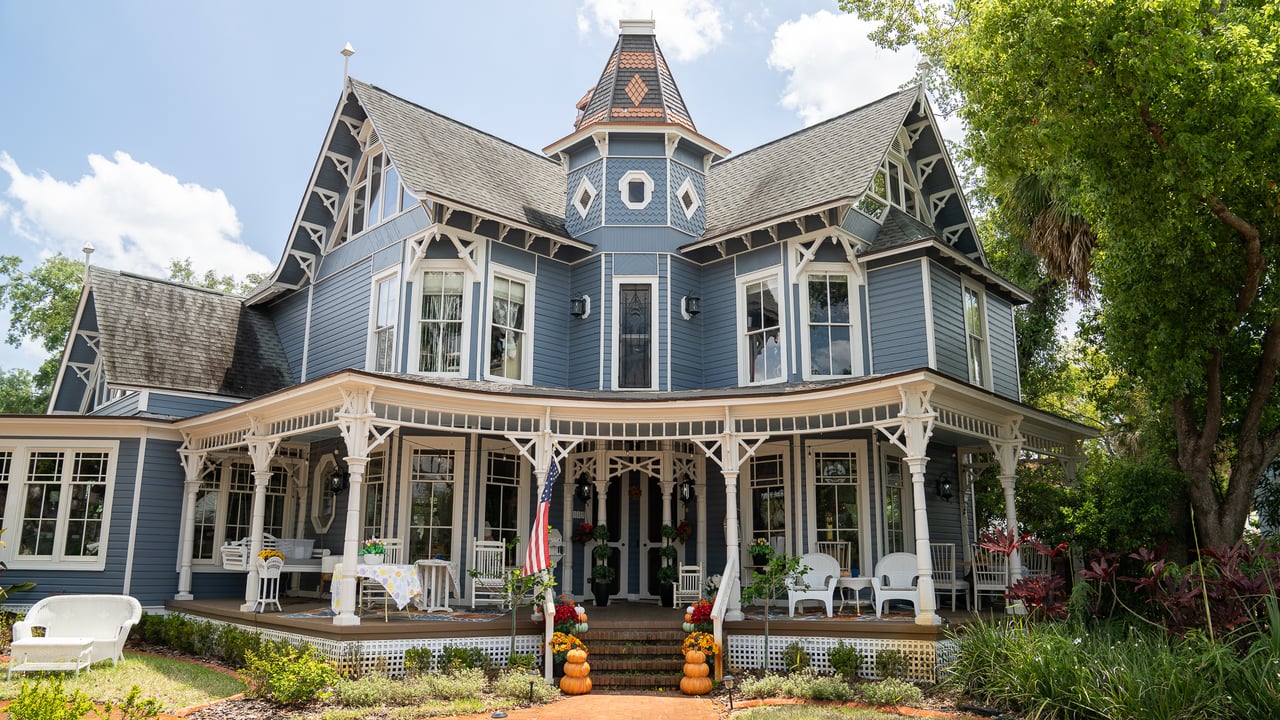
Tarpon Springs became the first incorporated city in what is now Pinellas County on February 12, 1887. The county itself didn't exist yet — Pinellas wouldn't separate from Hillsborough County until 1912. But twenty-five years earlier, on Spring Bayou, a small group of Northern investors, former territorial governors, hardware magnates, and winter-resort pioneers met in a living room and voted to formally create a city. That meeting, by most accounts, happened inside one of the homes I was photographing yesterday — the Knapp House at 115 S Spring Boulevard, a circa-1886 Queen Anne Revival that still stands today, curved porch and all, on the corner directly across from Craig Park.
When I stand in front of the Knapp House with my camera, I try to remember this. The civic structure that eventually became Pinellas County — with its roughly one million residents today, its cities, its school districts, its local governments, its whole built environment — can trace a real causal line back to a meeting held behind those walls in 1887. Most places don't have landmarks that specific. Most regions' founding moments happen in places that have long since been torn down. Spring Bayou is one of the exceptions.
The full story of the Knapp House is worth its own careful reading, and I wrote it on my historic homes site: Read the complete history of the Knapp House here. What I want to do in this post is different — less a building-by-building history, more a walk through what Spring Bayou actually feels like, and why it matters that it still exists at all.
Most Tampa Bay real estate coverage focuses on the same handful of historic neighborhoods. Hyde Park in Tampa. Historic Old Northeast and Snell Isle in St. Petersburg. Old Seminole Heights. These are the marquee addresses, and they deserve their recognition.
But Spring Bayou in Tarpon Springs is, quietly, one of the most architecturally significant historic residential streets in the state of Florida — and it's almost never mentioned in that conversation. The Florida Master Site File, the official state inventory of historic resources, documents dozens of pre-1940 structures in the Spring Bayou and greater Tarpon Springs historic core. The Anson P.K. Safford House at 23 Parkin Court, built circa 1883, is among the oldest documented frame residences in Pinellas County. The Knapp House at 115 S Spring Boulevard, circa 1886, is a textbook Queen Anne Revival of exceptional architectural quality. The William T. Fleming House at 22 N Spring Boulevard, the Marshall H. Alworth House at 144 N Spring Boulevard, the Rev. Miles Standish House at 127 S Spring Boulevard, and many others form an almost unbroken streetscape of 1880s and 1890s residential architecture.
To put that in perspective: most Tampa Bay historic neighborhoods are, at their oldest, products of the 1910s and 1920s. A Craftsman bungalow in Old Seminole Heights from 1915 is rightfully considered historic. Spring Bayou's homes are thirty years older than that. The homes here predate the Great Fire of 1894 that destroyed much of Tarpon Springs' commercial downtown. They predate the arrival of the Greek sponge-diving industry in 1905. They predate Pinellas County itself. They were built when Tarpon Springs had barely 300 residents, when the railroad had just arrived, when the entire Florida Gulf Coast was still a frontier.
And most of them are still standing. This is what makes Spring Bayou genuinely extraordinary.
The home I spent the most time photographing yesterday was the Knapp House — or Crescent House, as it's known locally for its signature curved front porch.
Viewed from directly in front, the home reveals itself the way good Queen Anne Revival architecture is supposed to. The three-story massing draws your eye upward through layered gables, decorative millwork, and the ornamented roofline that defines the style. The curved porch sweeps outward from the front of the home in an elegant crescent, its spindle work and turned columns reading like lace against the painted siding. The original stained glass windows catch the afternoon light in patterns that shift as you move.
What you don't see from the street, but what I know from the research and restoration history, is that the home's interior retains heartwood pine floors, approximately 37 different varieties of Florida hardwoods used throughout the original construction, a double-sided fireplace, and original architectural detailing that was preserved through the transformative 1976-1979 restoration by then-owner Donald Scholl. The modern systems of the home were rebuilt from the ground up in the late 1970s, but the historic material fabric — the wood, the windows, the decorative elements — was preserved.
This is the kind of home that cannot be reproduced at any price in 2026. The old-growth timber is gone. The craftsmen who built homes this way in the 1880s have no successors. The time it took to build something like this — months of skilled labor on decorative millwork alone — is not something any contemporary budget can truly recapture.
Standing in front of the home with my camera, what I kept thinking about was how lucky we are that it's still here at all. Most homes like this one — Queen Anne Victorians built by 1880s investors in small Florida resort towns — were lost over the decades. To hurricanes. To fires. To demolition for commercial development. To gradual neglect when subsequent owners couldn't or wouldn't maintain them. The Knapp House survived all of it. And we're looking at it today because of specific people at specific moments who made specific decisions to keep it standing.
I want to be honest about something. Tarpon Springs is often overlooked in Tampa Bay real estate conversations, and I think that's a mistake.
The city sits at the far northern edge of Pinellas County, about 45 minutes from downtown Tampa and 30 minutes from downtown St. Petersburg. It's known nationally for its Greek heritage, its Sponge Docks, and the St. Nicholas Greek Orthodox Cathedral — all of which are genuinely unique cultural assets. What gets less attention is that Tarpon Springs is also, in terms of surviving late-19th-century architecture, one of the most important historic communities in Florida.
The reasons it gets overlooked are partly geographic. Tarpon Springs is far enough from the Tampa Bay metropolitan core that it doesn't show up in most "Tampa Bay" coverage, even though it's technically within the region. It's also partly cultural — the Sponge Docks draw so much attention that the Spring Bayou historic residential district, which is quieter and less commercial, sits almost in the Sponge Docks' shadow for most visitors.
But for buyers specifically interested in historic architecture, for owners who value the kind of community where architectural heritage is genuinely protected, and for anyone who believes that the past matters — Tarpon Springs deserves a much higher place on the Tampa Bay historic homes list than it typically receives.
The homes here command prices that, in my view, often understate their genuine architectural and historic significance. A Queen Anne Victorian on Spring Bayou in comparable architectural condition to a Mediterranean Revival on Davis Islands will typically trade at a meaningful discount to the Davis Islands property. Some of that discount is legitimate — Davis Islands has the prestige, the proximity to downtown Tampa, the coherent 1920s planned community character. But some of it is simply a market blind spot. Tarpon Springs' historic inventory is underpriced relative to what it actually is, and sophisticated buyers have been quietly figuring this out.
A few observations that walking Spring Bayou regularly has genuinely taught me, in no particular order.
Landscaping matters enormously to how a historic home reads. The Spring Bayou homes with mature oaks, thoughtful foundation plantings, and considered hardscape consistently present substantially better than identical homes with neglected landscapes. The historic value is the same in both cases; the buyer response is dramatically different.
Original material honesty shows in photographs in ways that contemporary modifications don't. A Queen Anne Victorian with original stained glass reads differently than the same home with vinyl replacement windows, even from twenty feet away. Buyers with design sensibilities register this immediately, often below the level of conscious attention. The homes that retain material authenticity photograph beautifully and hold their value. The homes that have been stripped of original elements tell you, visually, that something is wrong — even when buyers can't articulate exactly what.
Neighborhood coherence compounds value. Spring Bayou's architectural concentration isn't just beautiful to walk through; it materially raises every individual home's value. A well-preserved historic home on a street of other well-preserved historic homes is worth substantially more than the same home on a street where the neighbors have replaced their original architecture with contemporary finishes. The Spring Bayou homeowners who maintain their properties aren't just protecting their own homes — they're protecting every home on the street.
Historic homes photograph best in soft light. Yesterday afternoon's overcast Florida sky was nearly ideal — no harsh shadows on the decorative woodwork, no blown highlights on white trim, no deep shadows hiding architectural detail. The homes revealed themselves. This is why the best architectural photography of historic Florida homes tends to happen in morning fog, late-afternoon overcast, or the hour before sunset. Midday Florida sun flattens architectural detail and washes out color; soft light lets the buildings breathe.
If Spring Bayou and the broader Tarpon Springs historic core are on your list of potential neighborhoods, a few practical observations worth having.
Architectural authenticity should be your single most important evaluation criterion. The homes here range from substantially original (with significant architectural integrity preserved) to extensively modernized (with much original character lost). The pricing between these two categories varies less than it should, creating genuine opportunities for buyers who know how to evaluate what they're looking at.
Flood zone awareness is essential. Spring Bayou is, by its nature, waterfront. Post-Hurricane Helene, flood zone designation, elevation, and mitigation status affect every property type in Tampa Bay, and waterfront historic homes are no exception. Elevation certificates, insurance history, and post-storm documentation should be part of your due diligence on any specific property.
Restoration specialists are limited. Tarpon Springs has a meaningful community of craftsmen and specialists familiar with 1880s construction methods, but the pool is smaller than in more central Tampa Bay markets. Building a relationship with a specialist who understands historic homes before you close — or better, before you make an offer — will serve you well over decades of ownership.
The community itself supports historic homeowners. The Tarpon Springs Area Historical Society, local preservation organizations, and the long-tenured residents of the Spring Bayou district represent a genuine support network for anyone taking on one of these homes. This matters more than buyers typically realize — the difference between owning a historic home in a community that values preservation and owning one in a community indifferent to it affects everything from contractor availability to neighborhood cohesion to the home's long-term value trajectory.
I've written the definitive account of the 1886 Knapp House — including Edwin Knapp's role in Tarpon Springs' 1887 incorporation, the architectural details that make the home significant, Donald Scholl's 1970s restoration, the 37 varieties of Florida hardwoods used throughout the original construction, and the home's status as one of the most photographed residences in Pinellas County — on my historic homes site.
Read the complete history here: https://historichomestampabay.com/journal-knapp-house-115-s-spring-blvd-tarpon-springs/
Whether you're considering the purchase of a historic home in Tarpon Springs, preparing to sell one, or simply curious about what this part of Pinellas County offers — I'd be glad to have the conversation. Tarpon Springs' Spring Bayou district represents one of the most architecturally significant historic neighborhoods in Florida, and homes here deserve representation that actually understands what they are.
Call 727-871-SOLD (727-871-7653) or reach out through the Contact page to start the conversation.
Stay up to date on the latest real estate trends.
Ready to elevate your real estate experience? Partner with us for personalized service, unparalleled expertise, and a proven track record. Whether buying, selling, or seeking valuation, let's turn your property goals into reality. Contact us today for a journey beyond expectations.