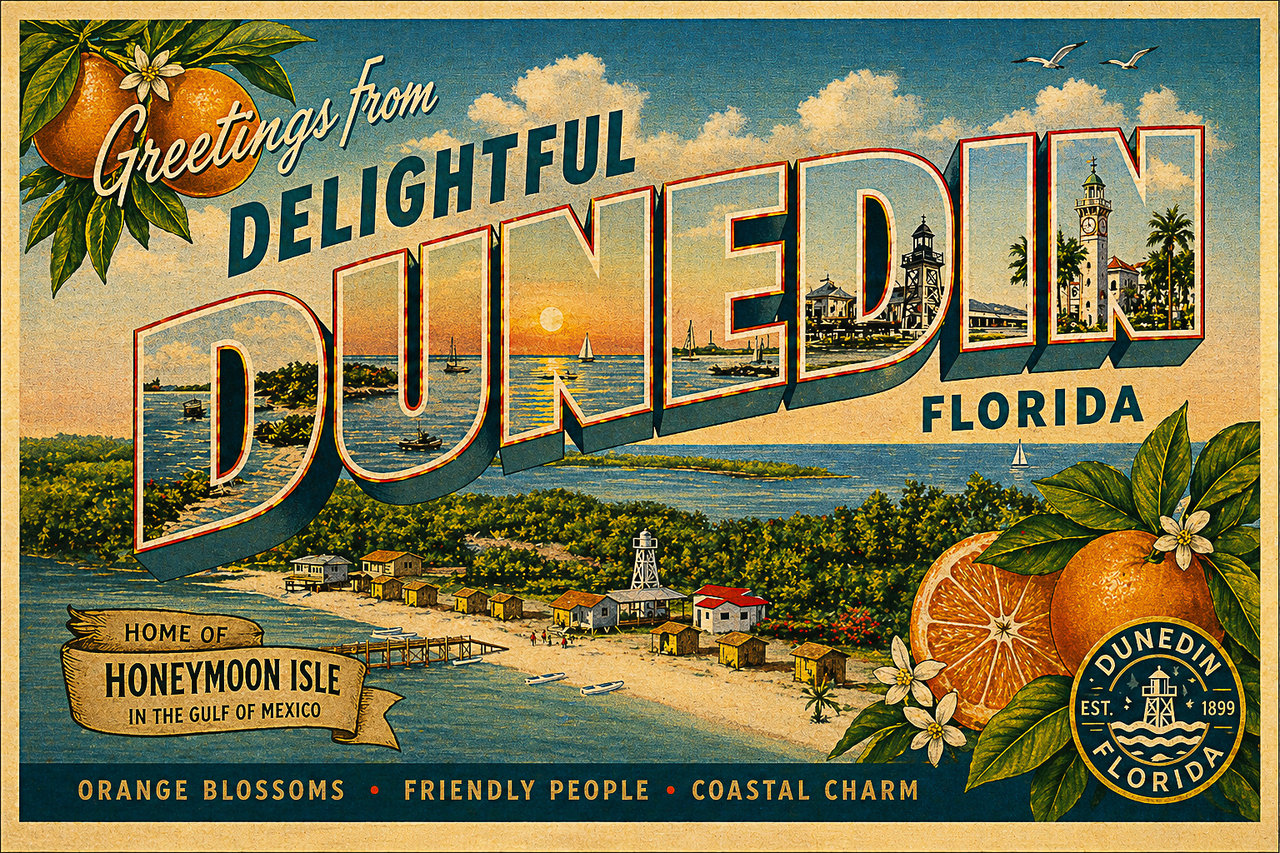
Living in Dunedin, Florida: The Complete 2026 Guide to Homes, Neighborhoods, and Lifestyle
Compass Mark Middleton April 27, 2026
Compass Mark Middleton April 27, 2026
If you are reading this, you are probably considering Dunedin as a possible move. Maybe you have visited a few times. Maybe you have walked Main Street on a Saturday afternoon, watched the boats come in at the marina, taken the causeway out to Honeymoon Island, and thought what a lot of people who visit Dunedin eventually think: this is a town I could actually live in.
I have lived here since 2013. I bought my home in the historic core, raised my professional life around this market, serve on the Board of Directors of the Dunedin History Museum, and have spent more than a decade learning what living here actually involves. What follows is the practical guide I wish more buyers had access to before they started shopping — the comprehensive look at neighborhoods, housing types, market dynamics, and the realities of relocating to or moving within Dunedin in 2026.
This piece is intended for buyers actively considering a Dunedin purchase, owners considering a sale or upsize within the market, or anyone trying to evaluate Dunedin against other Tampa Bay or Gulf coast options. It runs longer than a typical neighborhood overview because the subject genuinely warrants the depth. Skim what you need; come back to the rest as your search progresses.
For the broader argument about why Dunedin matters as a town, you can read my LinkedIn article on why Dunedin is one of the best small towns in the United States. For the architectural and historical depth on the town's historic homes specifically, my Journal piece on Dunedin historic homes covers what the present guide treats more briefly. For the visual experience of the town itself, my Dunedin documentary on YouTube renders what walking the streets actually feels like. This guide is the practical companion to all three.
Dunedin occupies a roughly four-square-mile footprint on the Gulf coast of northern Pinellas County, between Clearwater to the south and Palm Harbor to the north, with the Gulf of Mexico defining the town's western edge. The municipal population is approximately 36,000 residents, though the broader unincorporated community surrounding the city limits adds meaningfully to the practical residential market that buyers consider.
The town's geographic positioning matters in ways that affect daily life directly. Tampa International Airport is roughly 25 miles east, accessible in 35 to 50 minutes depending on traffic. St. Pete-Clearwater International Airport is closer, at roughly 12 miles. Downtown Tampa is 25 to 35 minutes. Downtown St. Petersburg is 30 to 40 minutes. The major Gulf coast beaches — Clearwater Beach, Indian Rocks Beach, Madeira Beach — are 15 to 30 minutes south. Honeymoon Island and Caladesi Island, two of Florida's most celebrated beaches, are accessible directly from Dunedin via the causeway.
This positioning means Dunedin offers the small-town life that the LinkedIn article argues for, while keeping residents within practical reach of the cultural amenities, professional services, healthcare, and air travel infrastructure of a major metropolitan area. The combination is unusual. Most American small towns require either remoteness (which limits practical access to metropolitan amenities) or suburban integration (which sacrifices the small-town character entirely). Dunedin manages both.
Dunedin contains a meaningful number of distinct neighborhoods, each with its own character, pricing dynamics, and buyer fit. Understanding the differences is essential to making the right purchase decision.
The Historic Core (Downtown Dunedin) — The original platted town, surrounding and immediately adjacent to the Main Street commercial district. This is the walkable, architecturally distinguished historic neighborhood that anchors much of what makes Dunedin distinctive. Inventory includes Folk Victorian and Queen Anne homes from the 1880s and 1890s, Craftsman bungalows from the 1910s and 1920s, Mediterranean Revival residences from the 1920s, Florida Vernacular cottages, Colonial Revival homes, and some thoughtful infill construction from more recent decades. Pricing varies meaningfully by specific block, condition, and architectural integrity; well-restored historic homes in this area regularly transact in the upper six figures and into seven figures, while smaller cottages and bungalows in good condition can be found at more accessible price points. Walkable to Main Street, the Pinellas Trail, and the marina.
Edgewater and Waterfront Areas — The neighborhoods immediately along the western waterfront, with direct or near-direct Gulf access. Inventory ranges from historic homes from the early 1900s on the original waterfront streets (Victoria Drive, Edgewater Drive) to mid-century homes to substantial new construction on premium lots. Waterfront pricing in Dunedin reflects the genuine scarcity of the inventory — there are not many homes with direct Gulf access, and the inventory transacts at premium pricing accordingly. Buyers should pay particular attention to elevation, flood zone status, and post-Helene insurance realities in these areas.
Curlew Creek and Northern Dunedin — Newer subdivisions in the northern portions of the city and adjacent unincorporated areas, generally featuring 1980s through 2000s construction in the form of single-family homes on larger lots, townhomes, and some condominium developments. These neighborhoods offer more conventional Florida suburban configurations — garages, larger lots, contemporary floor plans — at price points that are typically more accessible than the historic core. Less walkable, more car-dependent, but practical for buyers whose lifestyle priorities favor conventional housing.
Patricia Avenue and Southern Dunedin — The neighborhoods south of downtown, mixing older Florida homes from the 1940s through 1970s with later infill. These areas offer a middle ground between the architectural distinctiveness of the historic core and the conventional newer construction of the northern neighborhoods, often at the most accessible price points within the city limits.
Lakeside and Lake Communities — Dunedin contains several inland lakes, including Lake Saundra and others, around which residential neighborhoods have developed. These communities offer waterfront character without Gulf coast pricing, and they can represent strong value for buyers who want lake views and waterfront recreation without the premium of saltwater frontage.
Condominium and Multi-Family Inventory — Dunedin offers a meaningful inventory of condominiums, townhomes, and multi-family residences across various price points. Older condominium buildings (1970s through 1990s) require post-Surfside due diligence on milestone inspections, structural integrity reserve studies, and reserve funding — considerations that have transformed the Florida condominium market substantially since 2022. Newer condominium developments and townhome communities offer more straightforward purchase processes but typically at higher per-square-foot pricing.
Surrounding Unincorporated Areas — Some buyers consider properties in the unincorporated areas immediately surrounding Dunedin proper, often referred to colloquially as Dunedin even though they are technically outside the municipal boundaries. These areas can offer larger lots, more privacy, and sometimes meaningful pricing differences, though buyers should understand the differences between municipal services, school district boundaries, and zoning rules that distinguish unincorporated parcels from incorporated properties.
The right neighborhood within Dunedin depends substantially on what you actually want from daily life. Walkable historic urbanism points to the historic core. Waterfront lifestyle points to Edgewater or the immediate Gulf-facing areas. Conventional Florida suburban living with practical price points points to the northern subdivisions. Lake life points to the inland lake communities. Condominium ownership requires its own due diligence layer. Generic "where should I buy in Dunedin?" advice is meaningless without understanding which of these distinct sub-markets actually fits your goals.
The architectural inventory of Dunedin spans roughly 140 years of residential construction, and the variety is genuinely substantial.
Pre-1900 homes — The earliest surviving residences in Dunedin, built during the founding decades of the 1880s and 1890s, are concentrated in the historic core. These homes are rare, architecturally distinguished, and represent some of the oldest surviving residential inventory in all of Pinellas County. The J.O. Douglas home on Scotland Street, still standing as a private residence, is among the most historically significant of these.
1900-1930 homes — The largest stratum of historic residential inventory in Dunedin dates from the early twentieth century through the boom era. Folk Victorian, Florida Vernacular, Craftsman bungalow, Colonial Revival, and Mediterranean Revival homes from this period form much of the architectural fabric of the historic core and the older waterfront streets. For buyers specifically seeking historic character with documented provenance, this is the inventory to focus on. My Journal piece on Dunedin's historic homes covers the architectural details at substantially greater depth.
1930s-1950s homes — A meaningful inventory of homes from the late Depression and post-war eras exists throughout Dunedin, often featuring Minimal Traditional, early Ranch, and modest mid-century styles. Many of these homes have been renovated multiple times across the intervening decades, and condition varies dramatically. Smaller in scale than typical contemporary construction but often on generous lots and in established neighborhoods.
1960s-1980s homes — The post-war Florida population growth produced substantial subdivision development across this period. Ranch-style homes, split-levels, traditional two-story Florida homes, and the various conventional residential configurations of the era all exist in meaningful inventory. These homes typically offer practical floor plans, attached garages, and the conveniences of mid-century suburban construction at price points generally below the historic core.
1990s-2010s homes — Newer subdivision construction throughout the northern and outer portions of the city offers contemporary floor plans, larger lot sizes, attached garages, and the layout efficiencies of recent residential design. These homes appeal to buyers prioritizing conventional residential configurations and contemporary systems.
New construction (2010s-present) — Continuing infill construction and selective new development across the city offers buyers the option of contemporary new homes, often on lots where earlier homes have been removed. Quality varies meaningfully by builder; the best new construction respects the scale and character of surrounding neighborhoods, while the less thoughtful examples do not.
Condominiums and townhomes — The town's multi-family inventory includes some of the older condominium buildings dating from the 1970s and 1980s (which now carry post-Surfside due diligence requirements) and newer townhome and condominium developments serving downsizers, second-home buyers, and snowbird residents. Pricing per square foot tends to be higher than detached homes, but bundled amenities and reduced maintenance burden can justify the premium for the right buyer.
Waterfront homes — Dunedin's Gulf-facing inventory is genuinely limited and commands premium pricing. The supply of homes with direct or near-direct waterfront access has not grown meaningfully in decades and cannot grow substantially in the future. For buyers prioritizing waterfront living, the inventory is what it is, and competing for it requires both financial resources and patience.
Several specific market realities define Dunedin in early 2026 that buyers should understand before submitting an offer.
The post-Helene bifurcation is real and ongoing. Hurricane Helene's September 2024 landfall transformed the Tampa Bay residential market in ways that continue to shape buyer behavior. Coastal and lower-lying neighborhoods experienced flooding and have seen post-storm pricing pressure. Inland and elevated neighborhoods have seen pricing strength. Dunedin contains both — some areas of the city are in higher-risk flood zones with documented Helene impacts, while other areas remained dry and elevated. The specific property's elevation, flood zone status, and Helene damage history are not optional considerations; they are foundational due diligence for any 2026 purchase. Buyers who skip this analysis risk overpaying for properties whose insurance costs and long-term resilience profiles do not match their pricing assumptions.
Insurance availability and cost matter substantially. The Florida insurance market has been genuinely challenging for several years, and the pressure has intensified rather than abated. Many standard carriers have restricted or declined coverage on older homes, on properties in higher-risk flood zones, and on homes with specific construction characteristics. Wind mitigation features (impact-rated windows, hip roofs, secondary water barriers) substantially affect premium availability and cost. For Dunedin specifically, the town's mix of historic homes and waterfront properties means insurance considerations affect the practical purchase decision in ways that have become more consequential than they were five years ago. Get real insurance quotes from multiple carriers within the first week of being under contract — not in the final week before closing.
Inventory has stabilized but remains modest. After the volatile 2020-2022 period and the post-Helene adjustments of 2024-2025, Dunedin inventory in early 2026 is more balanced than it was during the COVID boom but still constrained by the town's geographic limits. Fewer than 50 single-family homes are typically on the market within Dunedin city limits at any given time, and quality inventory in the historic core or waterfront areas often transacts within weeks of listing. Buyers serious about the market need to be positioned to move decisively when the right property surfaces.
Pricing has moderated but remains substantial. Dunedin pricing peaked in 2022 alongside the broader Tampa Bay market, moderated through 2023 and 2024, and has stabilized through 2025 into 2026. Specific tiers of the market have moved differently — modest historic cottages and bungalows have held value better than larger waterfront estates, condos have faced more pressure than detached homes due to post-Surfside dynamics, and new construction has performed differently from existing homes. Buyers should be working from current data on specific property types within specific Dunedin sub-markets, not from broader Tampa Bay or Florida averages.
Buyer competition varies substantially by property. Generic Dunedin listings face moderate buyer competition. Exceptional listings — well-restored historic homes in the core, true waterfront properties, properties with documented Flood Zone X status, and homes in the most desirable specific blocks — face substantially more competition. Strategic buyer positioning matters more than ever, and buyers without specialized representation often miss exceptional inventory because their representation cannot recognize what is exceptional.
Statistics and architectural inventory descriptions can only convey so much. What Dunedin actually offers as a place to live is something more specific.
Mornings often begin downtown. The Pinellas Trail runs directly through the heart of the city, and the morning rhythm of cyclists, runners, dog walkers, and stroller-pushing parents using the trail establishes the day's tempo. Coffee shops on Main Street open early. The marina is active by 7 AM as boaters head out for the day. By 9 AM, the downtown streets are populated with people doing what residents of genuine small towns actually do — running errands, meeting friends, working from cafés, picking up groceries, walking dogs.
Afternoons stretch differently in Dunedin than they do in most Florida communities. The walkable downtown, the proximity to Honeymoon Island, the active marina, and the established café culture mean residents have practical alternatives to driving everywhere. Many Dunedin residents do drive — this is still Florida — but they often drive less than they would in the typical Tampa Bay suburban community, and the difference compounds across daily life into something noticeable.
Evenings are the time when Dunedin's downtown vitality becomes most visible. Main Street's restaurants fill. The breweries — Dunedin has become one of Florida's most concentrated craft beer destinations, with multiple independent breweries within walking distance of each other — host the kind of Friday and Saturday evenings that genuine small-town downtowns produce. Performances at the Dunedin Fine Art Center, events at the Andrews Memorial Chapel, and the rotating schedule of community festivals throughout the year add cultural depth that most Florida small towns cannot match.
Saturday mornings are the Dunedin Downtown Market. Open year-round, drawing meaningful crowds of residents, neighbors, and visitors, the market has become one of the central institutions of the town's social life. Local farmers, prepared food vendors, craft producers, artists, and community organizations populate the market each week. Spending an hour at the Saturday market is, for many Dunedin residents, both grocery shopping and weekly community participation simultaneously.
The annual events that punctuate the calendar — the Dunedin Highland Games (held since 1966 and the largest Scottish heritage festival in Florida), the Dunedin Wines the Blues Festival, the Mardi Gras celebration, the Dunedin Holiday Festival Parade, the Old Fashioned Fourth of July, and the various smaller seasonal events — give the year a structure that residents actually mark on their calendars. These are not generic small-town events; they are specifically Dunedin events with deep local roots, and participation in them is one of the ways residents actually become part of the community rather than just living in proximity to it.
Spring training season, from mid-February through late March, brings the Toronto Blue Jays to TD Ballpark for their annual training schedule. The team has trained in Dunedin since 1977, and the spring training relationship is part of the rhythm of late winter and early spring for residents. Game tickets are accessible, the ballpark experience is genuinely intimate, and the player-family-fan culture of Dunedin spring training offers something that no major-market team experience replicates.
The natural amenities — Honeymoon Island, Caladesi Island, the Pinellas Trail, the inland lakes, and the Gulf shoreline — remain the foundational draw for many residents. Mornings on Honeymoon Island, weekend trips to Caladesi via the small ferry, sunset walks along the Dunedin Causeway, kayak outings on the inland lakes, and the regular patterns of beach and water access that genuinely waterfront communities offer all become part of daily life rather than special occasions.
This is what living in Dunedin actually involves. Not all of it appeals to all buyers. But for the buyers it does appeal to, the combination is rare enough to be worth the substantial decision of relocating.
For buyers with children or planning families, Dunedin's school situation deserves careful consideration. The town is served by the Pinellas County School District, with several public schools serving Dunedin specifically: San Jose Elementary, Curtis Fundamental Elementary, Dunedin Highland Middle School, and Dunedin High School are among the schools serving the community. School quality varies, and Pinellas County operates a complex choice system that gives families options beyond simple geographic boundaries. Specific school assignments, choice options, and program availability change over time and require current information from the school district directly.
Beyond public schools, the Dunedin area includes private school options including Catholic, independent, and Christian schools serving various grade levels. Several of the region's strongest private schools, including those located in Clearwater and the surrounding communities, are within practical commuting distance.
For buyers prioritizing specific schools, the school assignment for a particular property and the available choice options should be verified during due diligence. Specific school boundaries can affect both the buyer's experience and eventual resale value, and the assumptions buyers make about school assignments are not always accurate.
I have built my professional practice around historic and character homes across Tampa Bay, with Dunedin representing one of the markets I know most deeply. I have lived in Dunedin since 2013, owned a home in the historic core throughout that time, and accumulated the specific knowledge of the town's neighborhoods, housing types, market dynamics, and inventory patterns that come from a decade of direct daily presence in the market.
For buyers, this matters in ways that generalist representation cannot replicate. I can walk a property and read the architecture for what it actually is. I know which blocks within the historic core carry specific characteristics. I know which properties have flooded and which have not. I know which inspectors, contractors, insurance agents, and other specialized professionals actually serve historic Florida homes well. I know the inventory patterns — what comes to market when, what tends to transact quickly, what represents genuine value at a given price point. And I know the specific buyer-seller dynamics of this particular town in ways that take years of direct work to develop.
For sellers, the combination of Dunedin-specific market knowledge and Compass's broader marketing and referral infrastructure produces measurable outcomes. Compass's national and international referral network reaches qualified buyers who actively seek the kind of inventory Dunedin offers, including specifically the relocating professional and second-home buyer segments that represent meaningful demand for historic and character properties. The Compass Private Exclusive and Coming Soon programs allow seller positioning before a listing reaches the open MLS, which for distinctive historic properties often produces the strongest initial buyer interest. Compass's marketing infrastructure — architectural photography, narrative listing copy, video production, and the broader presentation work that separates premium real estate marketing from generic real estate marketing — supports the kind of listing presence that distinctive Dunedin properties actually warrant.
Beyond Compass's infrastructure, my own work focuses on what I think of as story-driven marketing for properties whose value is derived substantially from their historical, architectural, or location-specific character. I produced a documentary about Dunedin because I wanted to capture visually what the town actually represents — that documentary is available on YouTube and reflects the kind of work I bring to the marketing of significant properties.
This is the work I have built around homes like the ones in Dunedin's historic core, the waterfront properties, and the architecturally significant residences throughout the broader Tampa Bay region. For buyers and sellers who want representation that matches the specific qualities of the property and the specific demands of this particular market, the combination of Dunedin-specific knowledge and Compass-platform marketing is, I think, what specialized representation should look like.
For buyers serious about a Dunedin purchase, the process that produces the best outcomes typically follows a sequence rather than a rush.
Begin with extended research before active touring. Spend time reading about the neighborhoods. Walk the town in person across multiple visits if possible. Understand which sub-markets actually fit your goals. Learn the architectural styles and which appeal to your sensibilities. Become familiar with the basic market dynamics before you start looking at specific properties. The buyers who make the best Dunedin purchases are typically the ones who arrived informed rather than the ones who learned the market through the buying process.
Engage representation early, not late. Specialized representation in markets like this one matters substantially, and the value of that representation compounds across the entire process — from initial property selection to inspection strategy to negotiation to closing. Buyers who hire specialized representation early benefit from informed property recommendations, can move decisively when exceptional inventory surfaces, and benefit from the relationships and infrastructure that specialists build over years of work in the market.
Build the financing and insurance foundations early. Mortgage pre-approval, insurance availability quotes, and the practical financial framework of the purchase should all be established before you are negotiating on a specific property. For Dunedin specifically, getting real insurance quotes from multiple carriers early matters because some property types and locations carry insurance complications that significantly affect the practical purchase economics.
Conduct rigorous due diligence on each specific property. Standard inspection approaches do not work well for older homes, waterfront properties, or homes in specific flood zone categories. Specialized inspection, careful flood zone analysis, insurance verification, and the various property-specific due diligence items that this market demands all deserve specific attention rather than generic checklists.
Make decisive offers when the right property surfaces. Generic Dunedin listings offer time. Exceptional Dunedin listings — well-restored historic homes in the core, true waterfront properties, homes with documented Flood Zone X status, and inventory in the most desirable specific blocks — often face competitive buyer dynamics. Strategic offer positioning matters, and buyers without specialized representation often lose exceptional inventory because they hesitated where decisiveness was warranted.
Plan for ownership rather than just purchase. Dunedin homes — particularly historic homes — require ongoing stewardship that includes specialized contractors, attentive maintenance, and the kind of relationship with the home that goes beyond simple occupancy. Buyers who plan for stewardship from the beginning have better long-term experiences than buyers who treat the purchase as the end of the work rather than the beginning.
Whether you are exploring Dunedin specifically, comparing it against other Tampa Bay or Gulf coast options, preparing to sell a home within its boundaries, or simply researching the town before narrowing your search — I would welcome the conversation. Every Dunedin purchase is specific. The right approach depends on the home, your goals, your timeline, and what you are actually trying to accomplish in this move.
For the broader argument about why Dunedin matters as a town, my LinkedIn article on why Dunedin is one of the best small towns in the United States makes the case in detail. For the architectural and historical depth on Dunedin's historic homes, my Journal piece covers what this guide treats more briefly. For the visual record of the town itself, my Dunedin documentary on YouTube captures what the words can only describe.
But the most important step is the conversation about what you are actually trying to accomplish, what the right Dunedin neighborhood is for your specific goals, and how to position yourself to make the right purchase when the right property surfaces.
Call 727-871-SOLD (727-871-7653) or reach out through the Contact page to start the conversation.
Stay up to date on the latest real estate trends.

Ready to elevate your real estate experience? Partner with us for personalized service, unparalleled expertise, and a proven track record. Whether buying, selling, or seeking valuation, let's turn your property goals into reality. Contact us today for a journey beyond expectations.