
Honeymoon Island and the Dunedin Causeway: A Resident’s Practical Guide
Most visitors to Honeymoon Island arrive on the kind of weekend afternoon when the parking lot is full, the beach is busy, and the experience is essentially the same as visiting any popular Florida state park. They get what they came for — beach time, family photographs, the satisfying check-mark of a well-known destination. They leave by late afternoon and rarely return.
What they miss is what the island actually is for residents. Honeymoon Island for someone who lives in Dunedin is something fundamentally different from Honeymoon Island for a Saturday tourist. It is a daily-life amenity that residents access at hours and in seasons when most visitors are not there, that they incorporate into routine activities rather than reserving for special occasions, and that they understand at a level of detail that the standard tourist visit cannot produce. This understanding is one of the things that genuinely distinguishes Dunedin residential life from the lives of nearby suburban Pinellas County communities, and it is one of the practical considerations that buyers evaluating Dunedin should understand before deciding whether the town fits their goals.
I have lived in Dunedin since 2013. I have walked Honeymoon Island in every season, at every hour, in every kind of weather. I have introduced more visiting family members than I can count to the island as part of standard Dunedin hospitality. I have used the island as a regular component of my own weekly routine and as a reliable destination for clients during slow afternoons between showings. What follows is the practical knowledge I have accumulated about what proximity to this island actually involves — written for current residents who want to deepen their use of the amenity, for buyers evaluating Dunedin who want to understand what living near a state park actually means, and for visitors planning serious engagement beyond the standard weekend afternoon.
For the broader story of how Honeymoon Island came to be the protected state park it is today — the 1921 hurricane that created it, the 1939 developer who named it, the 1970 grassroots movement that saved it from residential development, and the broader civic argument about what the island represents — see my LinkedIn article: What Honeymoon Island Reveals About What Florida Almost Lost. This MiddletonTampaBay companion is the practical operational guide that the LinkedIn piece sets the foundation for.
For the broader argument about why Dunedin belongs in the conversation about America’s best small towns generally, my LinkedIn article on Why Dunedin Is One of the Best Small Towns in the United States makes the case at length. For the architectural and historical depth on the town’s historic homes, my Journal piece on historichomestampabay.com covers what this guide treats more briefly. For the visual experience of Dunedin itself, my documentary Delightful Dunedin on YouTube renders what the words cannot capture. And for the comprehensive practical guide to Dunedin neighborhoods, market dynamics, and lifestyle, my Living in Dunedin Guide is the full reference resource.
This piece is the dedicated guide to one specific dimension of Dunedin life. The other resources cover the broader landscape.
The Practical Geography
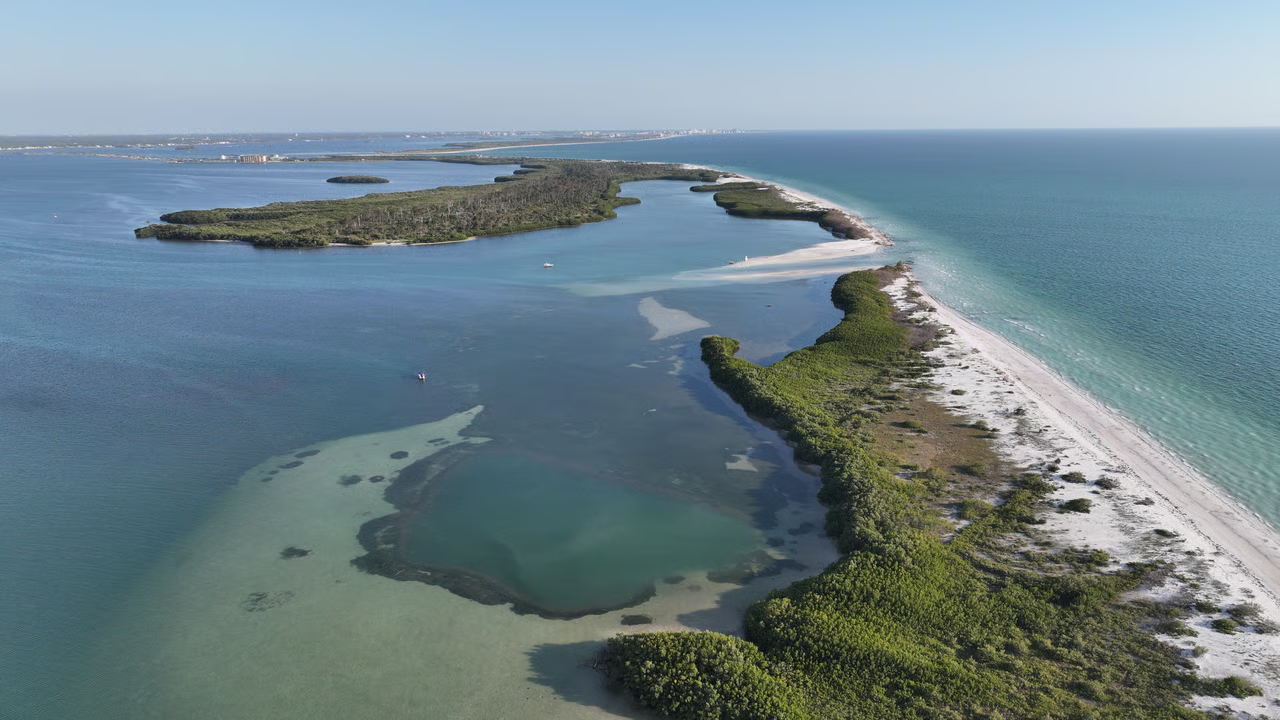
Honeymoon Island sits at the western end of the Dunedin Causeway, approximately a two-mile drive from downtown Dunedin. The causeway itself runs roughly two miles from the mainland to the island and is a meaningful destination in its own right — a long, narrow strip of land with water on both sides, with multiple pull-off areas where residents fish, kayak, watch sunsets, and walk dogs.
The island is approximately 2,800 acres of barrier-island land oriented north-south, with the Gulf of Mexico to the west and Saint Joseph Sound to the east. The main park entrance is at the southern end of the island, where the causeway terminates. Several beach access points are spread across the island’s western (Gulf-facing) shore, with the largest beach areas concentrated near the main park facilities and additional more-remote beach access available via the various trails and walkways.
The southern tip of the island ends at Hurricane Pass — the waterway created by the October 1921 hurricane that originally split Hog Island into what are now Honeymoon Island and Caladesi Island. From the southern beach areas of Honeymoon, you can see Caladesi Island across the pass. The two islands together form one of the most architecturally significant preserved barrier-island landscapes on Florida’s Gulf coast.
For practical access purposes, residents and visitors arriving by car park at the main lot at the southern end of the island. Cyclists and walkers arriving via the Pinellas Trail can access the island via the causeway directly. Boat access is available throughout the surrounding waters, with mooring possibilities both in Saint Joseph Sound and in the Gulf depending on conditions.
The Seasonal Rhythm Most Visitors Miss
The single most important thing most visitors do not understand about Honeymoon Island is that it operates on completely different patterns depending on the season and the time of day. Casual weekend afternoon visits during peak tourist season produce one experience. Visits at other times produce fundamentally different experiences — and those alternative experiences are often what residents actually mean when they talk about the island.
Late fall through early spring (November through April). This is peak season for Honeymoon Island, but peak season has different meanings depending on the day of the week and the time of day. Weekends during this period, particularly Saturdays and Sundays from late morning through mid-afternoon, can produce parking lots that fill before 11 AM and beach experiences that feel substantially busier than the island’s natural character would suggest. Weekday mornings and weekday late afternoons during the same period offer fundamentally different experiences — substantial available parking, light beach use, and the kind of contemplative engagement with the island that the place was originally protected to make possible.
For residents and buyers considering Dunedin, this is one of the most important practical realities. Living in Dunedin means having the option to visit Honeymoon Island on a Tuesday morning at 9 AM in February, when the parking lot is one-third full, the beach is essentially empty north of the main facilities, and the island offers the kind of solitude that weekend tourists cannot find. This option does not exist for residents of more distant communities. It is one of the genuine privileges of Dunedin residency.
Late spring through early fall (May through October). This is off-season for tourism, with the island substantially less crowded across most days and most hours. Florida heat and humidity discourage the casual visitors who dominate winter weekends, and serious beach-going requires earlier morning hours and later afternoon hours to avoid the worst of the temperature. Residents who use the island regularly tend to shift their routines during these months — earlier morning beach walks, late afternoon and early evening sunset visits, swimming during cooler hours, and avoiding the midday window when both heat and the occasional storm activity make the island less hospitable.
The off-season also offers some of the most beautiful conditions of the year. Late September and October, after the worst of summer storm season has passed, often produce mornings of perfect light, warm-but-not-hot temperatures, and minimal visitor traffic. May offers similar conditions before summer’s full heat sets in. These shoulder-season periods are when residents who have lived in Dunedin for years often produce their most distinctive Honeymoon Island experiences.
The hurricane season variable. Florida hurricane season runs June 1 through November 30. Honeymoon Island, as a barrier-island state park, experiences direct impacts from major storms with varying frequency. Hurricane Helene in September 2024 produced substantial impacts requiring extensive recovery work, with portions of the island’s facilities still being restored as of late 2025. Hurricane Idalia in 2023 produced earlier impacts. Earlier storms over the past decade have similarly affected the island periodically.
For residents and buyers, this is a practical reality worth understanding. Living near a barrier-island state park means accepting that the park’s specific configuration will change periodically due to storm impacts, and that recovery work after major storms can affect access to specific facilities for extended periods. The island itself remains, and the broader natural amenity continues, but the specific built infrastructure of bathhouses, snack bars, ferry service, and similar facilities can be disrupted for weeks or months following significant storms.
Access by Foot, Bike, and Trail
The Pinellas Trail, the 47-mile rails-to-trails corridor that runs from St. Petersburg through Dunedin to Tarpon Springs, connects directly to the Dunedin Causeway and provides protected non-vehicle access to Honeymoon Island.
This connection is one of the most genuinely useful practical features of Dunedin life and one that most casual visitors to the area do not realize exists. From downtown Dunedin, a cyclist can ride the Pinellas Trail north to where the trail meets the causeway, then ride the causeway approximately two miles to the island entrance. The total ride from downtown to the island is roughly four miles each way — manageable for any reasonably fit adult, suitable for families with school-age children on appropriate bikes, and one of the more genuinely beautiful short rides in the entire Tampa Bay region.
For residents in Dunedin’s historic core neighborhoods, the trail-and-causeway combination provides daily-life-practical access to Honeymoon Island that supplements vehicle access in meaningful ways. Cyclists can avoid the parking lot situation entirely on busy weekends by riding rather than driving. Walkers can complete a substantial loop that takes them through downtown Dunedin, along the causeway, onto the island for beach time, and back, all under their own power. The combination of historic neighborhood walkability, trail access, and state park destination makes Dunedin one of the few Florida residential communities where genuinely active outdoor life is structurally enabled rather than dependent on automobile transportation.
For buyers evaluating Dunedin, the trail-and-causeway access pattern is worth understanding as part of the practical lifestyle proposition. Properties closer to the trail or in walkable proximity to the causeway entrance offer different daily-life affordances than properties more distant from these access points. The historic core of Dunedin, with its direct trail connection through downtown, is particularly well-positioned for residents who want to make non-automobile access to Honeymoon Island a regular part of their lives.
What the Island Actually Offers
Beyond beach access, Honeymoon Island offers several specific natural and recreational features worth understanding for sustained engagement with the park.
The Osprey Trail. A walking and hiking trail along the eastern (Saint Joseph Sound side) of the northern portion of the island, running through one of the few remaining old-growth slash pine forests in coastal Florida. Some of the trees along the trail are estimated at nearly 200 years old. The trail provides excellent wildlife viewing, particularly for raptors. Bald eagles, ospreys (the trail’s namesake), and great horned owls all nest on the island during winter and spring. The forest itself is genuinely distinctive — most coastal Florida forest of this age has been lost to development or to historic logging activity, and the Osprey Trail is one of the rare places where you can walk through a slash pine forest that approximates pre-development Florida.
The Pelican Cove Trail. A shorter trail offering similar wildlife viewing in a different ecosystem section of the island. Suitable for shorter walks or for visitors with limited time.
The shorebird and seabird population. Honeymoon Island is a significant nesting site for several shorebird species, including black skimmers, American oystercatchers, plovers, and various tern species. These birds rest on the beach throughout the year and nest in seasonal cycles. For birders specifically, the island is one of the more productive coastal Florida birding destinations.
Sea turtle nesting. Loggerhead and green sea turtles both nest on Honeymoon Island. Nesting season runs roughly May through October, with hatching activity during summer and early fall months. The Florida Park Service and various volunteer organizations actively monitor and protect nesting sites during the season. Residents who visit the island regularly during summer months may encounter marked nesting areas that should be respected and avoided.
Gopher tortoises. A significant population of gopher tortoises inhabits Honeymoon Island, particularly in the upland sections away from the beaches. These tortoises are an important indicator species for Florida ecosystem health, and observing them in their natural habitat is one of the genuine pleasures of repeated visits to the island.
Caladesi Island ferry access. Ferry service from Honeymoon Island to Caladesi Island operates seasonally, allowing visitors to access Caladesi (which has no automobile access) via short boat ride. The ferry was disrupted following Hurricane Helene in 2024 and resumed service during 2025 recovery operations. For residents, the Caladesi day trip is one of the most genuinely worthwhile uses of the broader Honeymoon Island access — Caladesi offers beach experiences that almost no other Florida location can match.
Picnic facilities, snack bar, and basic amenities. The main park area at the southern end of Honeymoon Island includes picnic tables (with a first-come basis), a concession with food and a gift store, kayak rentals, restroom facilities (recovering at varying rates following the 2024 storm impacts), and the kind of basic infrastructure that supports both casual visits and longer day-long engagements.
Kayak rentals. Rental kayaks are available on-site for paddling in Saint Joseph Sound or, depending on conditions, in the Gulf. The protected eastern waters of the island are particularly suitable for casual paddling, with calm conditions on most days and the kind of natural mangrove and seagrass environments that make the experience genuinely worthwhile.
What Living Near the Island Actually Means for Real Estate
For buyers considering Dunedin properties specifically because of Honeymoon Island access, a few practical observations.
Proximity matters at smaller distance scales than buyers usually expect. A home five minutes from the causeway entrance offers a fundamentally different daily-life relationship with the island than a home fifteen minutes away. The five-minute home invites spontaneous afternoon walks, short morning visits before work, and quick evening sunset trips. The fifteen-minute home requires more planning and produces less frequent visits as a result. Within Dunedin specifically, the historic core, the older waterfront streets, and the northern residential areas each have different practical relationships with the island, and these differences materially affect ownership experience.
Pinellas Trail access is its own value driver. Properties with direct or near-direct Pinellas Trail access have different lifestyle affordances than properties more distant from the trail. The trail is not just recreational infrastructure — it is the practical connection between residential life and the island, and the difference between a property where trail access is part of daily life versus a property where the trail is theoretically nearby but practically requires driving makes a substantial difference in how residents actually engage with the natural amenity.
Storm exposure and elevation considerations apply. Properties closer to the Gulf, particularly the older waterfront streets in Dunedin, carry storm exposure considerations that have become more central to real estate decisions following Hurricane Helene. Specific property elevation, FEMA flood zone status, and post-storm history are not optional considerations for buyers evaluating Dunedin properties in 2026. The island itself has demonstrated the storm-exposure realities of barrier-island Florida; nearby mainland properties carry related but distinct considerations.
Resale value patterns favor proximity. Across recent years, Dunedin properties with practical access to Honeymoon Island and the Pinellas Trail have demonstrated resilient pricing patterns relative to comparable Pinellas County inventory more distant from these amenities. This is not a temporary trend; it reflects the genuine and growing buyer recognition of natural amenity value in residential decisions. Properties that combine the natural amenity proximity with quality historic architecture and reasonable elevation profiles represent the strongest current Dunedin investment thesis.
The “Dunedin lifestyle” is not abstract — it is structurally enabled by Honeymoon Island. When buyers and real estate professionals talk about the distinctive Dunedin lifestyle, much of what they mean is structurally enabled by the island’s existence. The walkable downtown, the active outdoor life, the seasonal rhythm of residential routines, the Saturday morning farmers market that ends with afternoon island visits, the spring training season that pairs with state park weekend trips — all of this depends on having the natural amenity available within practical proximity. Properties that maximize this proximity offer something genuinely difficult to replicate in the broader Tampa Bay residential market.
Practical Tips for Sustained Engagement
For residents who want to deepen their relationship with Honeymoon Island, and for buyers evaluating Dunedin who want to understand what regular use actually looks like, several practical observations.
Visit on weekday mornings during peak season. This is the most underutilized window for resident-quality engagement with the island. Weekday mornings between November and April, ideally arriving before 10 AM, produce substantially available parking, light beach use, and the kind of contemplative experience that weekend visits cannot offer.
Use the off-season strategically. May, late September, and October offer some of the most beautiful conditions of the year with substantially fewer visitors than peak winter season. Residents who incorporate off-season visits into their routines benefit from the kind of empty-island experience that few Florida state parks offer outside of extreme weather conditions.
Develop a sunset routine. The western shore of Honeymoon Island offers genuine quality sunset experiences year-round. Building a regular sunset visit pattern — weekly, biweekly, or as scheduling allows — produces accumulated familiarity with the island that single-visit tourists cannot develop.
Use the trails beyond the beaches. The Osprey Trail and the Pelican Cove Trail offer experiences fundamentally different from beach visits. Residents who alternate beach and trail visits develop a much more complete relationship with the island’s actual character.
Consider the Caladesi day trip seriously. The ferry service to Caladesi Island, when operating, provides access to one of the most genuinely pristine remaining beaches on Florida’s Gulf coast. Most residents underuse this access. A Caladesi day trip during the right season is among the most worthwhile uses of Dunedin proximity.
Pay attention to storm cycles. The island’s specific configuration changes following major storms, with shorelines shifting, vegetation patterns adjusting, and built infrastructure recovering at varying rates. Residents who track these changes across years develop a much richer understanding of barrier-island ecology than visitors who encounter the island only in single moments.
Bring visiting family and friends. This is not generic hospitality advice — it is practical recognition that Honeymoon Island is one of the most reliable destinations for hosting visiting Northeasterners, Midwesterners, and other relatives whose own coastal experiences cannot match what Dunedin offers. Building this into standard hospitality routine deepens both your own engagement with the island and your visitors’ appreciation for what your residential choice provides.
A Note on What All of This Means
Living in Dunedin gives you a practical relationship with one of Florida’s most important preserved natural amenities. The relationship is structural — built into the daily geography of the town — rather than aspirational. You do not need to drive across the state to access Honeymoon Island; you live across the causeway. You do not need to plan special trips to engage with the natural amenity; you can incorporate it into ordinary routine. You do not need to choose between walkable urban life and access to genuine preserved nature; Dunedin gives you both within a single geography.
This is genuinely rare in American residential markets. Most communities offer either density and walkability without natural amenity proximity, or natural amenity access without urban life. Dunedin offers both, and the combination is much of what makes the town distinctive among Florida small towns and among American small towns generally.
For buyers evaluating whether Dunedin fits their goals, the question is not whether Honeymoon Island is a beautiful place — it is. The question is whether you actually want a daily-life relationship with this kind of preserved barrier-island state park as part of your residential routine. For some buyers, the answer is genuinely yes, and Dunedin offers something they cannot easily find elsewhere. For other buyers, the answer is no, and other communities will fit their goals better.
I work with both kinds of buyers. The right answer depends on the buyer, not on the merits of Dunedin. But for the buyers who want what Dunedin actually offers, Honeymoon Island is one of the central practical features that should inform their evaluation.
Considering Dunedin?
Whether you are evaluating Dunedin as a possible move, comparing it against other Tampa Bay or Gulf coast options, preparing to sell a Dunedin property, or simply researching the town before narrowing your search, I would welcome the conversation. Every Dunedin purchase is specific. The right approach depends on the home, your goals, your timeline, and what you are actually trying to accomplish.
For the broader argument about why Dunedin matters as a town, my LinkedIn article on why Dunedin is one of the best small towns in the United States makes the case in detail. For the broader story of how Honeymoon Island became the protected park it is today, my LinkedIn article on what Honeymoon Island reveals about what Florida almost lost provides the historical context. For the architectural and historical depth on the town’s historic homes, my Journal piece on historichomestampabay.com covers the architectural detail. For the visual experience of the town itself, my Delightful Dunedin documentary on YouTube renders what the words can only describe. For the comprehensive practical guide, my Living in Dunedin Guide is the full reference resource.
But the most important step is the conversation about what you are actually trying to accomplish, what the right Dunedin neighborhood is for your specific goals, and how to position yourself to make the right purchase when the right property surfaces.
Call 727-871-SOLD (727-871-7653) or reach out through the Contact page to start the conversation.